
Is Your Store Ready for the Shoppers Who Aren’t Human?
AI Is Becoming the First Stop in the Buying Journey, and Most Online Stores Aren’t Built for It Yet For most of the last decade, running a good online store meant winning the fight for human…

- 12 Min Read
- Jun 4, 2026
- 3 Views
- AI Is Becoming the First Stop in the Buying Journey, and Most Online Stores Aren’t Built for It Yet
- What the Gap Actually Is
- Why This Matters Now, Not Later
- The Three Gaps That Hold Most Stores Back
- 1. Catalog Readiness: Can an AI Understand What You Sell?
- 2. AI Visibility: Do You Even Know How You Show Up?
- 3. Operational Reliability: Can an AI Trust You?
- What Marketplaces Already Figured Out
- What an AI-Ready Store Actually Looks Like
- The Hidden Cost: Losing Sight of the Journey
- How to Start Closing the Gap
- Where CodeNdCoffee Fits In
- The Bottom Line
AI Is Becoming the First Stop in the Buying Journey, and Most Online Stores Aren’t Built for It Yet
For most of the last decade, running a good online store meant winning the fight for human attention. You polished your product pages, cleaned up checkout, made everything faster on mobile, worked on your search rankings, and tuned your recommendations. Every change had one goal behind it: make it easier for a person to find you, trust you, and buy from you.
That work still counts. But the people you’ve spent years optimizing for are starting to hand part of the job to something else.
A growing number of shoppers now start with an AI assistant. Instead of opening five tabs to compare options, they just ask. Instead of scrolling through filters, they describe what they want and let the assistant do the narrowing. The assistant reads specs, weighs reviews, checks prices, looks at delivery times, and comes back with a short list. Often the shopper hasn’t visited a single store yet.
So here’s the awkward question for every brand. When an AI does that comparison, does it understand your products well enough to recommend them?
For a lot of stores, the honest answer is “not yet.” Your site might look great to a human and still be close to invisible to the systems that now decide what that human sees first. The distance between how your store is built today and what AI-driven shopping rewards is what we call the AI commerce readiness gap. Closing it is turning into one of the clearest advantages an e-commerce brand can grab right now.
What the Gap Actually Is
Traditional e-commerce is built for the way people shop. We respond to good photography, marketing copy, smart navigation, and the comfort of a brand we already know. A human shopper fills in the blanks without thinking about it. They forgive a missing detail, they message support with a question, or they trust a product just because the page looks professional.
An AI agent doesn’t do any of that. It needs structure. It wants product data that is complete, consistent, and easy to compare against everything else it’s looking at. That means accurate pricing, real-time inventory, clear delivery windows, honest return policies, proper product attributes, sizing, and reviews it can actually read. Where a person sees a nice product photo and gets the idea, an agent needs the meaning written out in a form it can process.
When your product data is thin, your stock counts are unreliable, or your shipping promise is vague, the agent doesn’t stop to give you the benefit of the doubt. It moves on to a competitor whose information is easier to understand and recommend.
That’s why readiness isn’t a marketing problem you can fix with better copy or a chatbot plugin. It sits much deeper, in your catalog, inventory, pricing, fulfillment, search, content, and the integrations that tie all of it together. This is an infrastructure issue first.
Why This Matters Now, Not Later
For years the discovery battle happened on familiar ground: Google rankings, social feeds, marketplace placement, paid ads, and email lists. None of those channels has gone away. But a new layer has slipped in front of them, the AI assistant, and it changes who gets seen.
Think about the kinds of requests shoppers are already making:
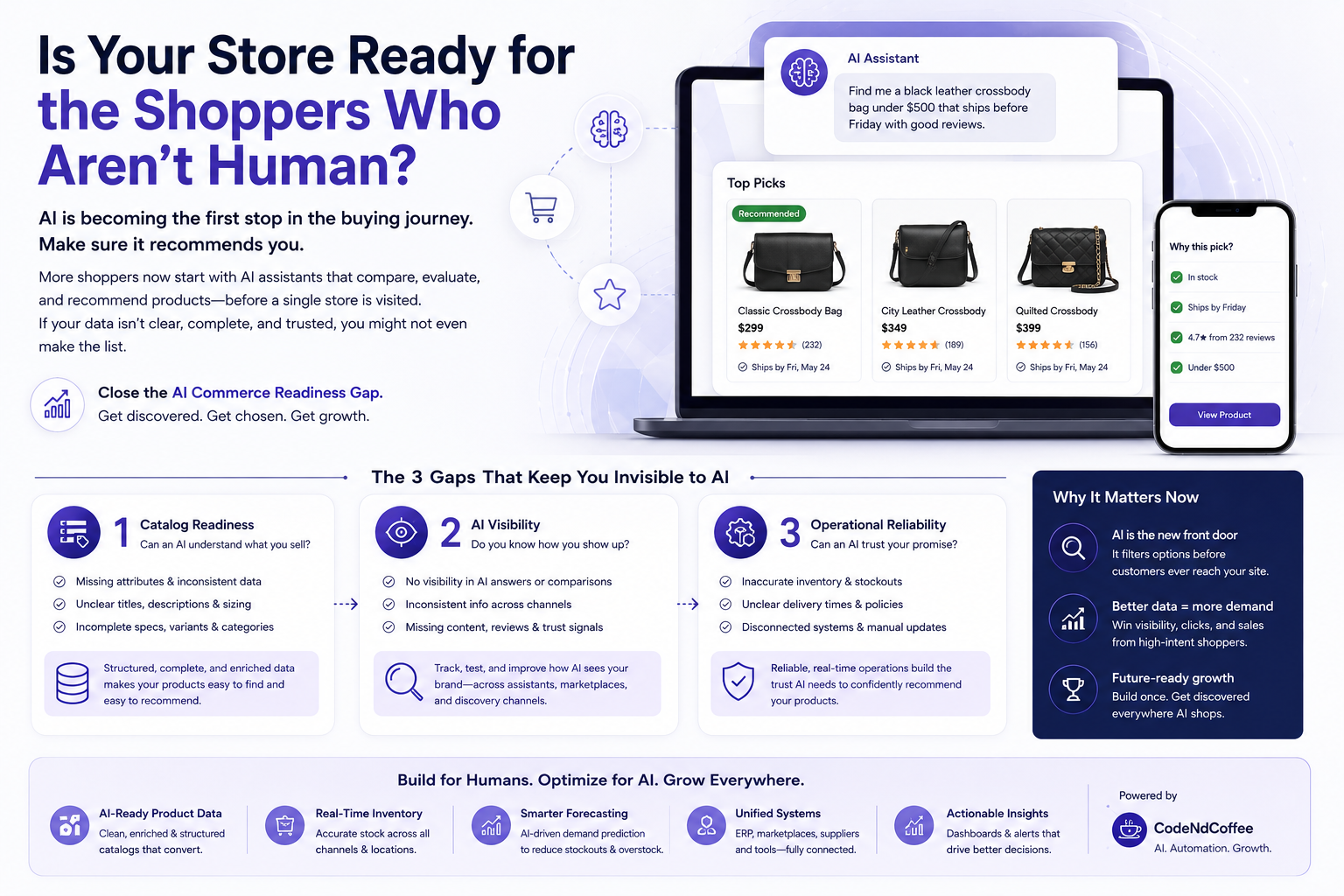
“Find me a black leather crossbody bag under $500 that ships before Friday.”
“Compare three skincare products for sensitive skin with good reviews and no fragrance.”
“What are the best office chairs for back pain under $300?”
In each of these, the customer may never touch your homepage, click through your collection pages, or use the filters you spent time building. The assistant becomes the first filter instead. In that moment, your product data is your storefront.
If your information is incomplete, you may not make the list at all. If your delivery promise is unclear, the assistant may quietly route around you. If your pricing, specs, or reviews don’t match up across the channels it checks, it will trust a more consistent source over yours. The demand doesn’t disappear. People still want to buy. It just flows toward the brands whose systems are ready to be understood by humans and machines at the same time.
The Three Gaps That Hold Most Stores Back
Here’s some good news. Most brands aren’t behind because they lack fancy AI tools. They’re behind because the foundations underneath aren’t ready. And those foundations tend to break in three predictable places: catalog readiness, AI visibility, and operational reliability.
1. Catalog Readiness: Can an AI Understand What You Sell?
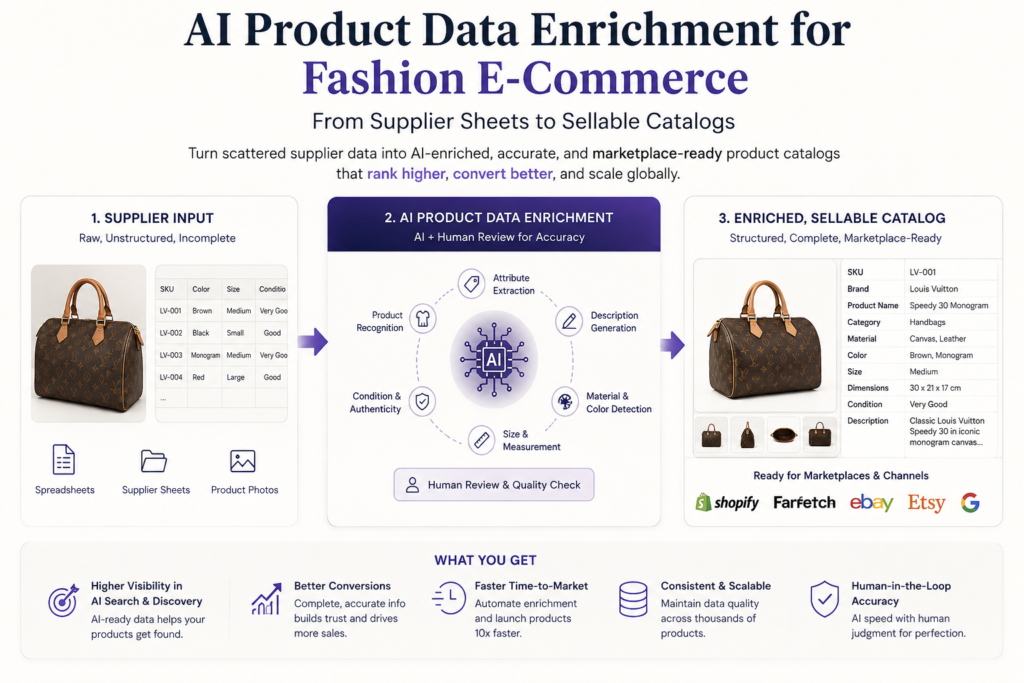
Everything starts with your catalog, because it’s the raw material every AI system reads. Inconsistent titles, weak descriptions, missing attributes, vague sizing, and unclear categories all make it harder for an agent to work out what a product even is, let alone whether to recommend it. The problem hits hardest in categories where detail is the whole point, like fashion, beauty, electronics, furniture, and health products.
Take a simple example. To a person, a photo labeled “Black Bag” is enough. To an agent, it’s almost meaningless. What the agent wants is the full picture: brand, product type, color, material, dimensions, closure, strap style, occasion, price, availability, and shipping options. Those details aren’t optional extras. They’re the only way the agent can line your bag up next to a dozen others and decide which one fits the request.
This is where cleaning and enriching your product data stops being housekeeping and starts being a growth lever. Structured, complete, comparison-ready listings are what make products discoverable in the first place.
2. AI Visibility: Do You Even Know How You Show Up?
You almost certainly track your Google rankings. You might watch marketplace positions and ad performance too. But ask how your brand appears inside AI-generated answers and most teams go quiet. That’s a brand-new blind spot.
When a shopper asks an assistant for a recommendation, a lot rides on things you can’t currently see. Does your brand come up at all? Are your products described accurately? Are competitors mentioned more often than you are? Is the AI working from old prices or stock counts?
Answering those questions is the job of Generative Engine Optimization, or GEO. The goal is to make your brand, products, and expertise easy for AI systems to understand, cite, and recommend. For an online store, GEO usually means structured product data and schema, strong category pages, useful buying guides and comparison content, clear FAQs, trustworthy reviews, consistent brand information, fast pages, and accurate price and inventory feeds. The next chapter of SEO won’t only be about ranking a page. It will be about being understood by the systems that summarize the web.
3. Operational Reliability: Can an AI Trust You?
Good product content gets you onto the short list. Reliable operations keep you there. The moment an assistant recommends something that turns out to be out of stock, mispriced, slow to ship, or wrapped in confusing return rules, the customer’s experience breaks. Recommendation systems learn from those failures. Over time, an unreliable store becomes a store the AI stops suggesting.
Staying trustworthy comes down to keeping the operational basics genuinely accurate: real-time inventory, correct pricing, clear delivery timelines, current return policies, consistent marketplace data, working APIs, and clean order and fulfillment workflows. For many brands this is the toughest gap of all, because the data lives scattered across Shopify, an ERP, supplier spreadsheets, warehouse tools, and a handful of third-party apps that don’t talk to each other. In the end, AI readiness is really a question of connected systems.
What Marketplaces Already Figured Out
If you want a preview of where AI commerce is heading, look at how marketplaces run, because they’ve been solving this problem for years. Managing dozens or hundreds of sellers forces a kind of discipline: structured data, seller validation, feed standards, automated audits, performance monitoring, and API-driven integrations. Those aren’t marketplace luxuries. They’re exactly the capabilities AI commerce rewards.
The lesson for a single-brand store is simple. Even if you never plan to run a marketplace, it pays to think like one. Build systems where product data is structured, inventory is accurate, suppliers are organized, and every product carries enough information to be found and compared. And if you’re looking at dropshipping, multi-vendor models, or supplier catalogs, that discipline isn’t optional. It’s the cost of entry.
What an AI-Ready Store Actually Looks Like
Becoming AI-ready isn’t about bolting a chatbot onto your site. It’s about building a stronger commerce foundation underneath everything, so a product stops being just a page and becomes a clean data object that humans, search engines, marketplaces, and AI agents can all read.
In practice, an AI-ready product record carries far more than a title and a photo. It includes a clear title and full description, structured attributes, proper categories, price and discount, real-time availability, delivery options, return eligibility, a size guide, images with alt text, reviews, FAQs, related products, marketplace mapping, schema markup, and even AI-generated summaries paired with human-approved product claims. That depth is what makes a product easy to surface and safe to recommend.
The Hidden Cost: Losing Sight of the Journey
There’s a quieter risk worth naming. Today, when shoppers land on your site, you can watch what they do. Page views, searches, add-to-carts, abandoned baskets, the whole conversion path. That visibility is valuable, and AI commerce threatens to dim it.
If the journey now starts inside an assistant, a lot of that behavior happens before anyone reaches your store. The AI compares options, builds a short list, summarizes your brand, and recommends one product while ignoring five others. All of it off your property and out of your analytics.
That changes what your website is for. It becomes less of a first-discovery point and more of the authoritative source of truth the AI checks against. So your site needs to say clearly and unmistakably what you sell, who it’s for, why it’s trustworthy, what makes your catalog different, what’s in stock, how fast you deliver, what your policies are, and why you deserve the recommendation. Put simply, it has to serve two audiences at once: the human deciding to buy, and the machine deciding whether to mention you.
How to Start Closing the Gap
The good news is you don’t have to rebuild everything at once. Readiness is something you can earn step by step.
Start with the catalog, since everything downstream depends on it. Clean up your titles, categories, attributes, descriptions, images, metadata, and schema. With that foundation in place, turn to inventory accuracy, because nothing kills trust faster than showing products as available when they aren’t, or letting stock updates lag across channels.
From there, work on your content. Add the buying guides, FAQs, and comparisons that answer the questions real shoppers ask, because that’s exactly the material AI systems lean on. Then connect the plumbing. Your platform, ERP, supplier system, marketplace feeds, warehouse tools, CRM, and analytics shouldn’t be running on separate islands. Finally, start watching your AI visibility directly. Search your brand, products, and categories inside the major assistants, check whether what they say is accurate, and note where the gaps are.
Treat this as an ongoing habit rather than a one-time project, because the systems on the other side keep changing too.
Where CodeNdCoffee Fits In
Real AI readiness takes more than content writing or a plugin install. It’s a practical mix of e-commerce strategy, data architecture, custom development, automation, marketplace integration, inventory systems, and product catalog workflows. That combination is exactly what we build.
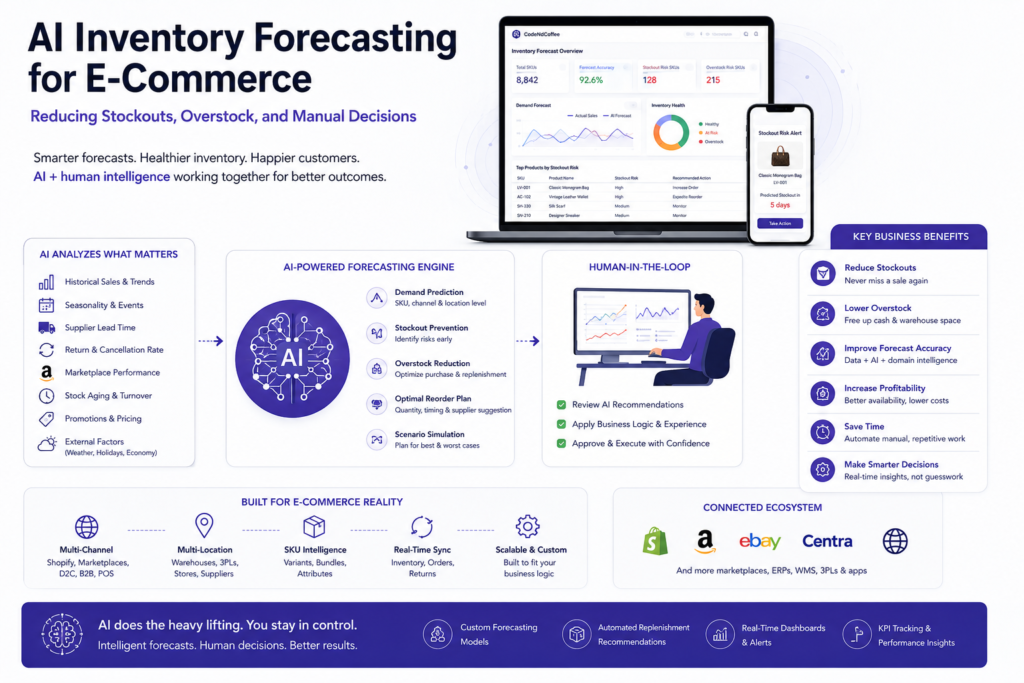
We help e-commerce businesses put that technical foundation in place. That covers product data enrichment and AI catalog automation, Shopify and custom development, marketplace integrations, supplier management and inventory synchronization, AI inventory forecasting, product feed automation, GEO support, custom Laravel and Vue systems, API integrations, e-commerce dashboards, and AI agent workflows.
Our approach is fairly plain. We don’t add AI for the headline. We start with your actual workflow, product data, operations, integrations, and growth goals, then design systems that make the business more scalable, more automated, and ready for what’s next. For most brands, the first move isn’t a sweeping AI transformation at all. It’s fixing the foundations that AI will quietly depend on.
The Bottom Line
AI commerce isn’t a forecast anymore. It’s already part of how people research, compare, and choose what to buy. The brands that come out ahead won’t simply be the ones with the prettiest websites. They’ll be the ones with clean data, reliable operations, structured product information, connected systems, and infrastructure an AI can trust.
The readiness gap is real, and that’s what makes it an opportunity. While your competitors keep filing product data, inventory accuracy, and integrations under “back-office problems,” you can pull them to the front and make them part of how you grow.
In the AI commerce era the rules shift in a quiet way. Your product data becomes your storefront. Your operations become your trust signal. Your website becomes your source of truth. And your technical infrastructure becomes a real competitive edge.
If you’re ready to close that gap, CodeNdCoffee can help you build the systems, automation, and integrations to compete in the agentic commerce era.
Enjoyed this article?
Share it with your network