
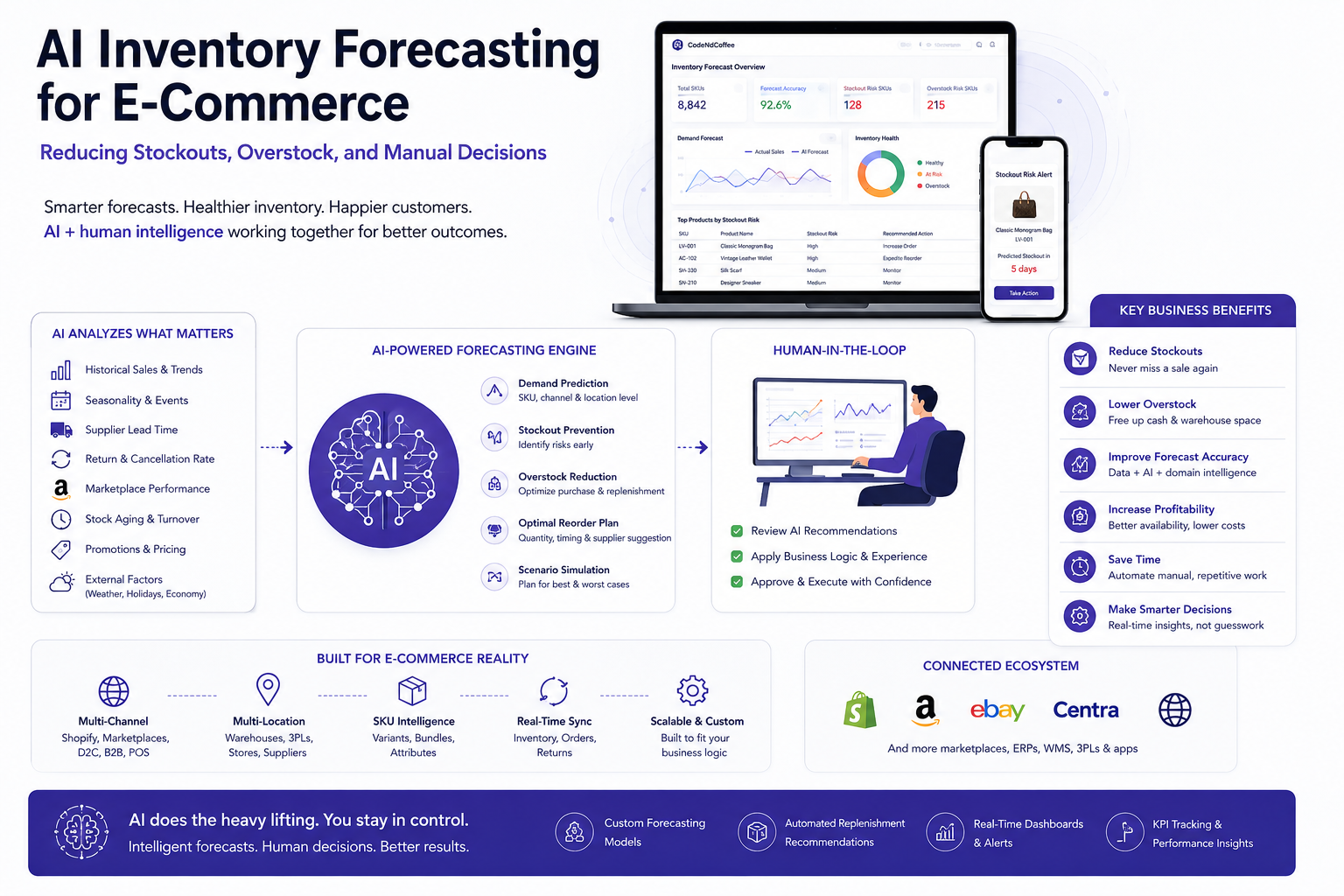
AI Inventory Forecasting for E-Commerce: Reducing Stockouts, Overstock, and Manual Decisions
How AI Helps E-Commerce Brands Forecast Demand, Improve Reordering, Protect Cash Flow, and Make Smarter Inventory Decisions Inventory is one of the most important parts of an e-commerce business. It directly affects sales, cash flow, customer…

- 23 Min Read
- Jun 4, 2026
- 4 Views
- How AI Helps E-Commerce Brands Forecast Demand, Improve Reordering, Protect Cash Flow, and Make Smarter Inventory Decisions
- What Is AI Inventory Forecasting?
- Why Inventory Forecasting Matters in E-Commerce
- Stockouts Cause Lost Revenue
- Overstock Traps Cash
- Manual Decisions Become Unreliable at Scale
- Supplier Lead Times Create Risk
- Marketing Campaigns Can Break Inventory Planning
- The Difference Between Demand Forecasting and Inventory Forecasting
- How AI Reduces Stockouts
- 1. Sales Velocity Monitoring
- 2. Reorder Point Calculation
- 3. Safety Stock Recommendations
- 4. Supplier Lead Time Analysis
- 5. Campaign-Aware Forecasting
- 6. Stockout Probability
- How AI Reduces Overstock
- 1. Slow-Moving Stock Detection
- 2. Stock Aging Analysis
- 3. Demand Decline Detection
- 4. Category-Level Overstock Insights
- 5. Cash Flow Protection
- Why Manual Inventory Planning Fails as E-Commerce Grows
- Common Problems with Manual Inventory Planning
- Data Needed for AI Inventory Forecasting
- 1. Historical Sales Data
- 2. Current Inventory Data
- 3. Supplier Data
- 4. Product Data
- 5. Marketing and Promotion Data
- 6. Returns Data
- 7. External Signals
- AI Inventory Forecasting for Fashion E-Commerce
- AI Inventory Forecasting for Shopify Stores
- AI Inventory Forecasting for Custom E-Commerce Platforms
- Practical AI Forecasting Features E-Commerce Brands Should Build
- 1. Stockout Risk Dashboard
- 2. Overstock Risk Dashboard
- 3. Reorder Recommendation Engine
- 4. Supplier Lead Time Monitor
- 5. Campaign Inventory Readiness Check
- 6. Slow-Moving Stock Recommendations
- 7. Forecast Accuracy Tracking
- Human-in-the-Loop Forecasting
- Common Mistakes in AI Inventory Forecasting
- Mistake 1: Forecasting from Incomplete Data
- Mistake 2: Ignoring Supplier Lead Time
- Mistake 3: Treating All Products the Same
- Mistake 4: No Human Approval
- Mistake 5: Not Tracking Forecast Accuracy
- Mistake 6: Ignoring Cash Flow
- How to Start Implementing AI Inventory Forecasting
- Phase 1: Audit Current Inventory Decisions
- Phase 2: Clean and Connect Data
- Phase 3: Build Basic Forecasting Dashboards
- Phase 4: Add AI Recommendations
- Phase 5: Add Approval Workflows
- Phase 6: Improve Forecasting Over Time
- Example: AI Inventory Forecasting Workflow
- Step 1: Data Integration
- Step 2: Sales Velocity Calculation
- Step 3: Stockout Risk Detection
- Step 4: Overstock Detection
- Step 5: Campaign Readiness
- Step 6: Purchase Order Drafting
- Step 7: Weekly AI Summary
- AI Inventory Forecasting and E-Commerce Profitability
- Why Work with CodeNdCoffee for AI Inventory Forecasting?
- Final Thoughts
How AI Helps E-Commerce Brands Forecast Demand, Improve Reordering, Protect Cash Flow, and Make Smarter Inventory Decisions
Inventory is one of the most important parts of an e-commerce business. It directly affects sales, cash flow, customer experience, operations, marketing, and profitability.
If a product goes out of stock too early, the business loses sales. If too much stock is purchased, cash gets trapped in slow-moving inventory. If reorder decisions are made too late, supplier lead times create gaps. If forecasting is based only on gut feeling, the business becomes reactive instead of strategic.
For small and mid-sized e-commerce brands, inventory forecasting is often handled manually through spreadsheets, basic reports, warehouse counts, supplier messages, and team experience. This may work in the early stage, but as the business grows, manual forecasting becomes harder to manage.
The complexity increases when the brand sells across multiple channels:
- Shopify
- WooCommerce
- Amazon
- eBay
- Etsy
- TikTok Shop
- Instagram Shop
- Google Shopping
- Physical retail
- B2B orders
- Custom marketplaces
Each channel creates sales data, stock movement, returns, promotions, customer behavior, and operational signals. If this data is disconnected, inventory decisions become risky.
This is where AI inventory forecasting becomes valuable.
AI inventory forecasting for e-commerce uses artificial intelligence, machine learning, historical sales data, supplier lead times, stock movement, seasonality, promotional calendars, customer behavior, and operational rules to predict future demand and recommend better inventory actions.
The goal is not just to predict how many units will sell.
The real goal is to help the business answer better questions:
- Which products should we reorder?
- How many units should we reorder?
- When should we reorder?
- Which products are at risk of stockout?
- Which products are becoming overstock?
- Which products are slow-moving?
- Which products should be promoted?
- Which products should be discounted?
- Which suppliers are causing delays?
- Which products are tying up too much cash?
- Which items have demand but poor availability?
- Which campaigns may create inventory pressure?
For CodeNdCoffee, AI inventory forecasting connects directly with our work in e-commerce development, supplier management systems, marketplace integrations, custom inventory workflows, AI automation, and KPI dashboards. [Internal link: E-Commerce Development Services] [Internal link: AI Automation Services] [Internal link: Inventory Management Systems]
This article explains what AI inventory forecasting is, why it matters, how it reduces stockouts and overstock, what data it needs, how it works in real e-commerce operations, and how brands can build a smarter forecasting system.
What Is AI Inventory Forecasting?
AI inventory forecasting is the process of using artificial intelligence and data-driven models to predict future product demand and recommend inventory decisions.
In simple terms, it helps e-commerce teams understand what stock they will likely need in the future.
A basic inventory report may show:
- Current stock
- Sold units
- Available units
- Reserved units
- Reorder level
But AI inventory forecasting goes deeper.
It can consider:
- Historical sales
- Sales velocity
- Seasonality
- Promotions
- Supplier lead time
- Purchase orders
- Returns
- Stockouts
- Customer demand
- Channel performance
- Product lifecycle
- Pricing changes
- Marketing campaigns
- External events
- Warehouse availability
- Marketplace trends
- Product category behavior
For example, a normal report may say:
“Product A has 12 units left.”
An AI forecasting system may say:
“Product A has 12 units left, but it sells 4 units per day during campaigns. A campaign starts in 5 days, and supplier lead time is 14 days. This product is likely to stock out within 4 days after the campaign starts. Recommended action: reorder 80 units now or reduce campaign exposure.”
That is the difference between reporting and forecasting.
Reporting tells you what happened.
Forecasting helps you prepare for what is likely to happen next.
Why Inventory Forecasting Matters in E-Commerce
Inventory forecasting is important because inventory mistakes are expensive.
A product can be profitable on paper, but poor inventory decisions can still damage the business.
Stockouts Cause Lost Revenue
A stockout happens when customers want to buy a product, but the product is unavailable.
This creates multiple problems:
- Lost sales
- Wasted ad spend
- Poor customer experience
- Lower marketplace ranking
- Lower customer trust
- Missed repeat purchases
- Broken promotional campaigns
- Lower lifetime value
If a customer comes to your store, finds the right product, and sees “out of stock,” they may not wait. They may buy from a competitor.
For fashion, luxury, beauty, electronics, home goods, and fast-moving consumer products, stockouts can hurt both immediate revenue and long-term brand trust.
Overstock Traps Cash
Overstock happens when the business purchases more inventory than it can sell within a reasonable time.
This creates problems such as:
- Cash tied up in unsold products
- Higher storage costs
- Discount pressure
- Lower profit margins
- Old stock aging
- Warehouse congestion
- More complex operations
- Product obsolescence
- Poor buying decisions
For fashion e-commerce, overstock is especially risky because trends, seasons, sizes, and styles change quickly. A winter coat that does not sell during winter may require heavy discounting later. A trend-based product may lose demand after a few months.
Manual Decisions Become Unreliable at Scale
In the early stage, founders and managers may know their products closely. They may reorder based on instinct, experience, and simple sales reports.
But as the catalog grows, manual decision-making becomes harder.
A store with 50 products is manageable.
A store with 5,000 SKUs, multiple suppliers, multiple channels, returns, campaigns, and seasonal patterns is much harder to manage manually.
At that stage, the team needs a system that can detect patterns faster than humans.
Supplier Lead Times Create Risk
Forecasting is not only about demand. It is also about supply.
A product may be selling fast, but if the supplier takes 21 days to deliver, the reorder decision must happen much earlier.
Many stockouts happen not because the business did not notice demand, but because it noticed too late.
AI forecasting can combine sales velocity with supplier lead time to recommend reorder timing.
Marketing Campaigns Can Break Inventory Planning
A product may normally sell 2 units per day. But during an influencer campaign, email promotion, paid ad campaign, or seasonal event, it may sell 10 units per day.
If inventory planning does not include marketing activity, campaigns can create sudden stockouts.
AI forecasting can include promotional calendars and campaign data to adjust demand expectations.
The Difference Between Demand Forecasting and Inventory Forecasting
Demand forecasting and inventory forecasting are related, but they are not exactly the same.
Demand forecasting predicts how much customers may want to buy.
Inventory forecasting uses demand forecasts plus operational constraints to decide how much stock the business needs.
For example:
Demand forecast:
“This product may sell 300 units next month.”
Inventory forecast:
“We currently have 120 units, 30 units are reserved, supplier lead time is 18 days, safety stock should be 50 units, and expected demand is 300 units. Recommended reorder quantity: 260 units.”
Demand forecasting is about expected sales.
Inventory forecasting is about inventory decisions.
A strong e-commerce forecasting system should include both.
It should answer:
- Expected demand
- Current available stock
- Incoming stock
- Reserved stock
- Supplier lead time
- Safety stock
- Reorder point
- Reorder quantity
- Stockout risk
- Overstock risk
- Slow-moving risk
- Suggested business action
How AI Reduces Stockouts
Stockouts often happen because businesses react too late.
A team may notice a product is selling fast, but by the time they reorder, supplier lead time creates a gap. The product sells out before new stock arrives.
AI inventory forecasting helps reduce stockouts by detecting risk earlier.
1. Sales Velocity Monitoring
Sales velocity means how quickly a product sells over time.
For example:
- Product A sells 2 units per day.
- Product B sells 20 units per week.
- Product C sells 100 units per month.
AI can monitor sales velocity and detect changes.
If a product suddenly starts selling faster, the system can alert the team.
Example:
“Sales velocity for Product A increased by 65% in the last 10 days. Current stock may last only 6 days. Supplier lead time is 14 days. Reorder recommended.”
This gives the team more time to act.
2. Reorder Point Calculation
A reorder point is the stock level at which a business should reorder.
A simple reorder point may be based on average daily sales and supplier lead time.
For example:
Average daily sales: 5 units
Supplier lead time: 10 days
Safety stock: 20 units
Reorder point: 70 units
This means when stock reaches 70 units, the business should reorder.
AI can improve reorder points by adjusting them based on changing demand, seasonality, promotions, and supplier reliability.
[Internal link: Inventory Reorder Automation]
3. Safety Stock Recommendations
Safety stock is extra inventory kept to protect against uncertainty.
A business may need safety stock because:
- Demand changes suddenly
- Suppliers are delayed
- Campaigns perform better than expected
- Returns are unpredictable
- Marketplaces create sudden sales spikes
- Weather or events affect demand
AI can recommend safety stock levels based on product behavior.
Fast-moving products may need more safety stock. Slow-moving products may need less.
4. Supplier Lead Time Analysis
Many businesses use a fixed supplier lead time, but real supplier performance can vary.
One supplier may usually deliver in 10 days but sometimes take 18 days. Another may be more consistent.
AI can analyze actual supplier delivery history and adjust forecasts accordingly.
This helps the business avoid relying on unrealistic assumptions.
[Internal link: Supplier Performance Dashboard]
5. Campaign-Aware Forecasting
If a product is included in a major campaign, expected demand should increase.
AI can include:
- Email campaigns
- Paid ads
- Influencer campaigns
- Seasonal promotions
- Holiday sales
- New collection launches
- Marketplace campaigns
- Discount events
This helps the inventory team prepare before the campaign starts.
6. Stockout Probability
Instead of only saying “low stock,” AI can estimate stockout probability.
For example:
“Product A has a 78% probability of stockout within 14 days.”
This helps teams prioritize action.
Not every low-stock product is urgent. A slow-moving product with 5 units may be fine. A fast-moving product with 20 units may be at risk.
AI helps separate real risk from noise.
How AI Reduces Overstock
Overstock is the other side of the inventory problem.
If stockouts lose sales, overstock traps cash.
AI helps reduce overstock by identifying products that are unlikely to sell fast enough.
1. Slow-Moving Stock Detection
A product may have high stock but low sales.
AI can detect products that are moving slower than expected.
For example:
“Product B has 180 units in stock and sold only 8 units in the last 60 days. At current sales velocity, it may take 22 months to clear. Recommended action: discount, bundle, improve merchandising, or pause reordering.”
This helps teams act before stock becomes dead inventory.
2. Stock Aging Analysis
Stock aging shows how long products have been sitting in inventory.
For fashion, beauty, electronics, and seasonal categories, stock age matters.
Older stock may require:
- Promotion
- Discounting
- Bundling
- Better product placement
- Marketplace listing
- Liquidation
- Supplier return
- Content improvement
AI can identify products that are aging and recommend actions.
[Internal link: Stock Aging Report Development]
3. Demand Decline Detection
A product may sell well initially and then slow down.
AI can detect demand decline earlier than manual review.
Example:
“Product C had strong sales during launch but sales dropped 55% over the last 30 days. Current stock may be excessive. Recommended action: reduce reorder quantity and move product to promotional collection.”
4. Category-Level Overstock Insights
Sometimes overstock is not only a product issue. It may be a category issue.
For example:
- Too many summer dresses after season ends
- Too many small sizes
- Too many low-margin accessories
- Too many products from one supplier
- Too much stock in one color
- Too many products in a declining trend
AI can analyze overstock patterns across categories, brands, sizes, colors, and suppliers.
This helps improve future buying decisions.
5. Cash Flow Protection
Inventory is cash.
Every unsold product represents money that could have been used for marketing, hiring, software, product development, or new stock.
AI forecasting helps businesses avoid over-purchasing by giving clearer reorder recommendations.
This is especially important for small and mid-sized e-commerce brands where cash flow is limited.
Why Manual Inventory Planning Fails as E-Commerce Grows
Manual inventory planning often starts with spreadsheets.
A team may track:
- SKU
- Stock quantity
- Sold quantity
- Purchase price
- Supplier
- Reorder level
- Notes
This may be enough at the beginning.
But as the business grows, spreadsheets become risky.
Common Problems with Manual Inventory Planning
- Data becomes outdated quickly
- Multiple people edit different files
- Sales channels are not synced
- Returns are not included properly
- Reserved stock is ignored
- Supplier delays are not tracked
- Campaign impact is not measured
- Forecasts are based on guesswork
- Overstock is discovered too late
- Stockouts are discovered after customers complain
- Reports take too much time to prepare
- Team decisions depend on one experienced person
Manual planning also creates decision fatigue.
Every week, managers must decide what to reorder, what to discount, what to push in campaigns, and what to stop buying. Without a smart system, these decisions become slow and stressful.
AI forecasting does not remove human responsibility. It reduces the manual burden and gives humans better information.
Data Needed for AI Inventory Forecasting
AI inventory forecasting depends on data quality.
The more relevant and accurate the data, the better the forecast.
Important data sources include:
1. Historical Sales Data
This includes:
- SKU-level sales
- Daily sales
- Weekly sales
- Monthly sales
- Channel-level sales
- Sales by category
- Sales by variant
- Sales by location
- Sales during promotions
Historical sales show demand patterns.
2. Current Inventory Data
This includes:
- Available stock
- Reserved stock
- Incoming stock
- Damaged stock
- Returned stock
- Warehouse stock
- In-transit stock
- Safety stock
- Stock adjustments
Current inventory shows the real supply position.
3. Supplier Data
This includes:
- Supplier lead time
- Minimum order quantity
- Supplier reliability
- Cost price
- Delivery history
- Partial delivery behavior
- Supplier capacity
- Return-to-supplier history
Supplier data helps the system recommend realistic reorder timing.
4. Product Data
This includes:
- Product category
- Brand
- Variant
- Size
- Color
- Material
- Season
- Product lifecycle stage
- Launch date
- Discontinued status
- Margin
- Price
- Collection
- Tags
Product attributes help the system understand patterns between similar products.
5. Marketing and Promotion Data
This includes:
- Campaign dates
- Discount percentage
- Email campaigns
- Paid ad campaigns
- Influencer campaigns
- Marketplace promotions
- Seasonal events
- Product launches
Promotions can change demand significantly.
6. Returns Data
Returns affect real inventory and demand interpretation.
A product with high sales but high returns may not be as successful as it appears.
Useful return data includes:
- Return rate
- Return reason
- Restockable returns
- Damaged returns
- Exchange requests
- Size-related returns
- Quality-related returns
7. External Signals
Depending on the business, external signals may include:
- Holidays
- Weather
- Local events
- Fashion trends
- Competitor activity
- Marketplace ranking
- Economic conditions
- Social media trends
Not every business needs every external signal, but for some categories, these can improve forecasting.
AI Inventory Forecasting for Fashion E-Commerce
Fashion inventory is difficult because demand is affected by style, size, color, season, trend, and customer taste.
A black medium dress may sell fast, while the same dress in a less popular color may move slowly. A handbag may sell better in neutral colors. A coat may sell only during winter. A trend item may sell quickly for two months and then slow down.
For fashion e-commerce, AI forecasting should consider:
- Size-level demand
- Color-level demand
- Category-level demand
- Seasonality
- Product launch cycle
- Trend movement
- Return rate by size
- Return rate by category
- Stock aging
- Product photography quality
- Product description quality
- Price sensitivity
- Occasion-based demand
- Collection performance
- Similar product performance
For luxury and vintage fashion, forecasting can be more complex because many products are unique or limited in quantity.
In that case, forecasting may focus less on replenishing the same SKU and more on:
- Category demand
- Brand demand
- Price range demand
- Product type demand
- Style demand
- Supplier buying guidance
- Which types of products to source more often
- Which types of products to avoid
- Which items should be promoted faster
- Which items are likely to sell quickly
For example, a vintage luxury business may not reorder the exact same Chanel bag, but it can forecast that:
- Black designer shoulder bags are selling faster than beige totes
- Medium-size handbags have better conversion than oversized bags
- Products under $800 move faster than products above $1,500
- Certain brands have higher demand but longer time to source
- Products with complete condition details sell faster
This is still inventory forecasting, but at a category and buying-decision level instead of simple SKU replenishment.
AI Inventory Forecasting for Shopify Stores
Shopify gives merchants useful product, order, and inventory data, but many growing stores need deeper forecasting than basic reports.
A Shopify-based AI forecasting system can analyze:
- Shopify orders
- Product variants
- Inventory levels
- Locations
- Collections
- Discounts
- Customer segments
- Returns
- Shopify metafields
- Product tags
- Marketing campaigns
- Sales channels
- App data
- Marketplace feeds
Useful Shopify AI forecasting workflows include:
- Reorder recommendations
- Stockout alerts
- Slow-moving stock detection
- Variant-level forecasting
- Collection-level demand analysis
- Supplier lead time planning
- Campaign inventory checks
- Product launch forecasting
- Discount recommendations
- Weekly inventory summary
- Cash tied in inventory report
For example:
“Your best-selling black size M product may stock out in 9 days. Reorder should be placed this week because supplier lead time is 12 days.”
Or:
“The summer collection has 42% of stock older than 90 days. Consider a seasonal clearance campaign before launching new arrivals.”
For Shopify fashion stores, variant-level forecasting is especially important because size and color combinations behave differently.
AI Inventory Forecasting for Custom E-Commerce Platforms
Custom e-commerce platforms can support more advanced forecasting because the system can be designed around the business’s exact workflows.
A custom Laravel, Vue, React, or Next.js-based inventory forecasting system can connect:
- Supplier management
- Purchase orders
- Warehouse stock
- Product catalog
- Marketplace sales
- Shopify or WooCommerce data
- Returns
- Accounting
- ERP
- Shipping
- CRM
- Marketing campaigns
- Analytics dashboards
- AI models
- Approval workflows
This allows the business to build forecasting directly into operations.
For example, a custom system can show:
- Forecasted demand by SKU
- Forecasted demand by category
- Recommended reorder quantity
- Recommended reorder date
- Supplier lead time risk
- Stockout probability
- Overstock probability
- Slow-moving stock report
- Dead stock report
- Campaign readiness report
- Warehouse transfer recommendations
- Purchase order suggestions
- Manager approval workflow
Custom systems are especially useful when the business has unique rules.
For example:
- Different reorder rules by supplier
- Different margin targets by product type
- Different approval levels by purchase value
- Different stock rules by marketplace
- Different lead times by country
- Different safety stock levels by category
- Different aging thresholds by product type
Standard tools may not handle these rules properly. A custom forecasting system can.
Practical AI Forecasting Features E-Commerce Brands Should Build
A good AI inventory forecasting system should not only produce a chart. It should help the team take action.
Here are practical features to consider.
1. Stockout Risk Dashboard
This dashboard shows products likely to go out of stock soon.
It should include:
- SKU
- Product name
- Current stock
- Sales velocity
- Days of stock remaining
- Supplier lead time
- Stockout probability
- Recommended action
2. Overstock Risk Dashboard
This dashboard shows products with excessive stock.
It should include:
- Current stock
- Sales velocity
- Stock age
- Months to clear
- Cash tied in stock
- Recommended discount or campaign action
3. Reorder Recommendation Engine
This feature recommends:
- What to reorder
- When to reorder
- How many units to reorder
- Which supplier to use
- Expected stock coverage
- Estimated cost
- Approval requirement
4. Supplier Lead Time Monitor
This feature tracks:
- Average delivery time
- Delays
- Partial deliveries
- Supplier reliability
- Impact on stockouts
- Recommended buffer time
5. Campaign Inventory Readiness Check
Before launching a campaign, the system should check:
- Stock availability
- Forecasted demand
- Supplier lead time
- Top products at risk
- Products suitable for promotion
- Products that should be excluded
6. Slow-Moving Stock Recommendations
The system should recommend actions for slow stock:
- Discount
- Bundle
- Feature in collection
- Move to marketplace
- Improve product content
- Update product images
- Return to supplier
- Stop reordering
7. Forecast Accuracy Tracking
Forecasts should be measured.
The system should compare:
- Forecasted sales
- Actual sales
- Forecast error
- Stockout events
- Overstock events
- Reorder accuracy
This helps improve the model over time.
Human-in-the-Loop Forecasting
AI inventory forecasting should not remove human judgment.
A good forecasting system should assist decision-makers, not blindly make purchasing decisions.
This is especially important because AI may not know every business context, such as:
- Supplier relationship issues
- Upcoming brand changes
- Product quality concerns
- New competitor activity
- Planned campaigns not yet entered into the system
- Cash flow limits
- Warehouse constraints
- Strategic business decisions
The best model is human-in-the-loop forecasting.
AI can:
- Detect risks
- Generate forecasts
- Recommend reorder quantities
- Highlight slow-moving stock
- Suggest discounts
- Identify supplier problems
- Create purchase order drafts
- Prepare management reports
Humans should approve:
- Final purchase orders
- Large reorders
- Supplier negotiations
- Major discounts
- Product discontinuation
- Budget-sensitive decisions
- Strategic buying decisions
This gives the business the speed of AI with the control of human expertise.
Common Mistakes in AI Inventory Forecasting
AI inventory forecasting can create real value, but only when implemented correctly.
Mistake 1: Forecasting from Incomplete Data
If the system only uses sales data and ignores stockouts, returns, and supplier lead times, the forecast may be misleading.
For example, if a product sold only 10 units because it was out of stock for half the month, the system may think demand is low. In reality, demand may have been higher.
This is called censored demand.
A strong forecasting system should account for stockout periods.
Mistake 2: Ignoring Supplier Lead Time
Demand forecasting without supplier lead time is not enough.
A product may need reorder today even if it still has stock, because the supplier takes three weeks to deliver.
Mistake 3: Treating All Products the Same
Not every product needs the same forecasting method.
Fast-moving products, seasonal products, luxury products, new products, long-tail products, and one-of-one products behave differently.
The forecasting system should support different logic for different product types.
Mistake 4: No Human Approval
Fully automated purchasing can be risky.
AI should suggest purchase orders, but humans should approve important buying decisions.
Mistake 5: Not Tracking Forecast Accuracy
If forecast accuracy is not tracked, the business cannot improve the system.
A forecasting system should learn from actual outcomes.
Mistake 6: Ignoring Cash Flow
A reorder may look good from a stock perspective but bad from a cash flow perspective.
A smart forecasting system should consider business constraints such as budget, margin, storage cost, and cash availability.
How to Start Implementing AI Inventory Forecasting
A business does not need a complex AI system from day one.
The best approach is phased.
Phase 1: Audit Current Inventory Decisions
Start by reviewing:
- How reorder decisions are made
- Who makes them
- What data is used
- Which products stock out often
- Which products are overstocked
- Which suppliers are delayed
- Which categories tie up cash
- Which reports are missing
- Which tasks are manual
This gives a clear starting point.
Phase 2: Clean and Connect Data
Prepare key data:
- Product catalog
- Inventory transactions
- Orders
- Returns
- Suppliers
- Purchase orders
- Stock adjustments
- Marketing campaigns
- Marketplace sales
- Warehouse data
AI forecasting needs clean, connected data.
Phase 3: Build Basic Forecasting Dashboards
Start with practical dashboards:
- Days of stock remaining
- Low-stock products
- Fast-moving products
- Slow-moving products
- Stock aging
- Supplier lead time
- Sales velocity
- Reorder suggestions
This creates immediate operational value.
Phase 4: Add AI Recommendations
Once the data foundation is ready, add AI recommendations:
- Reorder quantity
- Reorder timing
- Stockout probability
- Overstock probability
- Discount suggestions
- Campaign readiness
- Supplier risk
Phase 5: Add Approval Workflows
Allow managers to approve AI recommendations.
For example:
AI suggests reorder
→ Manager reviews
→ Purchase order draft created
→ Supplier confirmation received
→ Inventory forecast updated
Phase 6: Improve Forecasting Over Time
Track forecast accuracy and business results.
Improve the system based on:
- Actual sales
- Missed forecasts
- Supplier delays
- Return rates
- Campaign outcomes
- Product lifecycle changes
- Category behavior
Example: AI Inventory Forecasting Workflow
Let’s imagine a growing fashion e-commerce business.
The company sells through Shopify, one marketplace, and occasional B2B orders.
The current problem:
- Some popular products stock out too quickly.
- Some seasonal items remain unsold.
- Reorders are based on gut feeling.
- Supplier lead times are not tracked properly.
- Marketing campaigns sometimes promote products with low stock.
- The founder has to manually review reports every week.
Now let’s add AI inventory forecasting.
Step 1: Data Integration
The system connects:
- Shopify orders
- Product catalog
- Inventory stock
- Purchase orders
- Supplier data
- Return data
- Marketing calendar
- Marketplace sales
Step 2: Sales Velocity Calculation
The system calculates how quickly each product sells.
It separates normal sales from promotional spikes.
Step 3: Stockout Risk Detection
The system identifies products likely to sell out before replenishment.
Example:
“Product A has 18 units left. Average daily sales are 3 units. Supplier lead time is 12 days. Stockout likely in 6 days. Recommended reorder: 60 units.”
Step 4: Overstock Detection
The system identifies products with too much stock.
Example:
“Product B has 150 units in stock and has sold only 5 units in 45 days. At current speed, stock may take more than 2 years to clear. Recommended action: include in clearance campaign.”
Step 5: Campaign Readiness
Before a campaign starts, the system checks inventory.
Example:
“Three products in the planned email campaign may stock out within 48 hours. Consider excluding them or increasing reorder priority.”
Step 6: Purchase Order Drafting
The system prepares reorder suggestions.
Managers approve or edit the recommendations.
Step 7: Weekly AI Summary
The founder receives a weekly summary:
- Products at stockout risk
- Products overstocked
- Supplier delays
- Reorder recommendations
- Campaign inventory warnings
- Cash tied in stock
- Slow-moving categories
- Forecast accuracy
This turns inventory planning from manual guesswork into a structured decision system.
AI Inventory Forecasting and E-Commerce Profitability
Inventory forecasting is not only an operations tool. It directly affects profitability.
Better forecasting can improve profit by:
- Reducing lost sales
- Reducing dead stock
- Improving cash flow
- Improving purchase planning
- Reducing emergency reorders
- Reducing storage costs
- Improving campaign performance
- Reducing discount dependency
- Improving supplier negotiations
- Improving product availability
For example, if a business constantly runs out of best sellers, it loses profitable sales.
If it constantly overbuys slow products, it loses cash and margin.
AI forecasting helps the business move toward a healthier balance.
The best inventory strategy is not “always have more stock.”
The best strategy is to have the right stock, in the right quantity, at the right time, based on realistic demand and supply conditions.
Why Work with CodeNdCoffee for AI Inventory Forecasting?
AI inventory forecasting requires more than installing a reporting plugin.
A serious forecasting system needs:
- Clean inventory data
- SKU-level sales history
- Supplier lead time tracking
- Product data architecture
- API integrations
- Forecasting models
- Business rules
- Approval workflows
- Dashboards
- Alerts
- Human-in-the-loop controls
- E-commerce domain expertise
CodeNdCoffee helps e-commerce businesses design and build custom systems that connect real operations with AI-powered decision support.
We can help with:
- AI inventory forecasting systems
- Inventory management dashboards
- Supplier management systems
- Purchase order workflows
- Stockout risk alerts
- Overstock detection
- Stock aging reports
- Shopify inventory automation
- Marketplace inventory sync
- Custom Laravel inventory systems
- E-commerce KPI dashboards
- AI reporting assistants
- Human-in-the-loop approval workflows
- Integration with ERP, CRM, warehouse, and marketplace systems
Our approach is practical.
We do not build AI systems just for the sake of AI. We start with the real business workflow: how products are bought, how stock moves, how suppliers deliver, how customers buy, how returns happen, and how managers make decisions.
Then we design a forecasting system that helps the team make faster, clearer, and more profitable inventory decisions.
For many e-commerce brands, the biggest opportunity is not adding more dashboards. It is turning inventory data into timely actions.
Final Thoughts
Inventory is one of the most important and expensive parts of an e-commerce business.
Poor inventory decisions create stockouts, overstock, cash flow problems, customer frustration, operational stress, and lower profitability.
AI inventory forecasting helps e-commerce brands move from reactive decision-making to proactive planning.
It can help businesses:
- Predict demand
- Reduce stockouts
- Reduce overstock
- Improve reorder timing
- Protect cash flow
- Track supplier lead times
- Prepare for campaigns
- Detect slow-moving stock
- Improve purchase planning
- Reduce manual reporting
- Support better management decisions
But AI forecasting only works well when it is built on clean data, connected systems, clear business rules, and human approval workflows.
The future of e-commerce inventory management is not just about counting stock.
It is about understanding demand, supply, timing, risk, and profitability together.
If your e-commerce business is ready to reduce stockouts, avoid overstock, and make smarter inventory decisions, CodeNdCoffee can help you design and develop an AI-powered inventory forecasting system tailored to your operations.
Enjoyed this article?
Share it with your network