
AI Product Data Enrichment for Fashion E-Commerce
How AI Turns Raw Supplier Data, Product Images, and Messy Catalogs into Conversion-Ready Fashion Listings Fashion e-commerce is no longer only about uploading beautiful product images and writing a short description. Today, the brands that win…

- 29 Min Read
- Mar 6, 2026
- 16 Views
- How AI Turns Raw Supplier Data, Product Images, and Messy Catalogs into Conversion-Ready Fashion Listings
- What Is AI Product Data Enrichment?
- Why Product Data Is a Growth Problem in Fashion E-Commerce
- 1. Slow Product Publishing
- 2. Inconsistent Product Titles and Descriptions
- 3. Weak Product Filtering
- 4. Poor Marketplace Performance
- 5. Poor SEO and AI Search Visibility
- Why Fashion E-Commerce Needs AI Product Data Enrichment More Than Other Categories
- Key Use Cases of AI Product Data Enrichment in Fashion E-Commerce
- 1. Supplier Data Cleaning
- 2. Product Attribute Extraction from Images
- 3. Product Title Generation
- 4. SEO Product Descriptions
- 5. Category and Taxonomy Mapping
- 6. Product Tagging and Merchandising
- 7. Marketplace Feed Optimization
- 8. Internal Search Improvement
- AI Product Data Enrichment and Generative Engine Optimization
- What Product Attributes Should Fashion Brands Enrich?
- Core Attributes
- Fashion-Specific Attributes
- Luxury and Vintage Attributes
- SEO and AI-Search Attributes
- Example: Before and After AI Product Data Enrichment
- Raw Supplier Data
- Enriched Product Data
- How AI Product Data Enrichment Improves Conversion Rates
- How AI Product Data Enrichment Improves Team Productivity
- How to Build an AI Product Data Enrichment System
- 1. Data Intake Layer
- 2. Product Data Model
- 3. AI Enrichment Layer
- 4. Human Review Layer
- 5. Publishing and Integration Layer
- 6. Feedback and Performance Layer
- Common Mistakes Fashion Brands Make with AI Product Enrichment
- Mistake 1: Letting AI Invent Product Details
- Mistake 2: Using Generic AI Descriptions
- Mistake 3: Ignoring Taxonomy
- Mistake 4: No Human Review
- Mistake 5: Not Connecting Enrichment to Business Goals
- AI Product Enrichment for Shopify Fashion Stores
- AI Product Enrichment for Custom E-Commerce Platforms
- How AI Product Enrichment Supports Marketplace Integrations
- Measuring the ROI of AI Product Data Enrichment
- Operational Metrics
- SEO and Discovery Metrics
- Conversion Metrics
- Merchandising Metrics
- Recommended Roadmap for Fashion Brands
- Phase 1: Audit Your Product Data
- Phase 2: Define Your Product Data Model
- Phase 3: Start with Semi-Automated Enrichment
- Phase 4: Add Image-Based Attribute Extraction
- Phase 5: Integrate with E-Commerce and Marketplace Systems
- Phase 6: Add Analytics and Continuous Improvement
- Why Work with CodeNdCoffee for AI Product Data Enrichment?
- Final Thoughts
How AI Turns Raw Supplier Data, Product Images, and Messy Catalogs into Conversion-Ready Fashion Listings
Fashion e-commerce is no longer only about uploading beautiful product images and writing a short description. Today, the brands that win online are the ones that can convert product information into structured, searchable, personalized, marketplace-ready, and AI-readable data.
For fashion brands, especially luxury, vintage, resale, and multi-brand retailers, product data is one of the biggest operational challenges. A single product may arrive with incomplete supplier information, inconsistent naming, missing attributes, poor image descriptions, unclear sizing, no condition details, and no standardized category structure. The result is slow product listing, poor search visibility, weak filtering, marketplace errors, lower conversion rates, and heavy manual work for internal teams.
This is where AI product data enrichment becomes a serious growth opportunity.
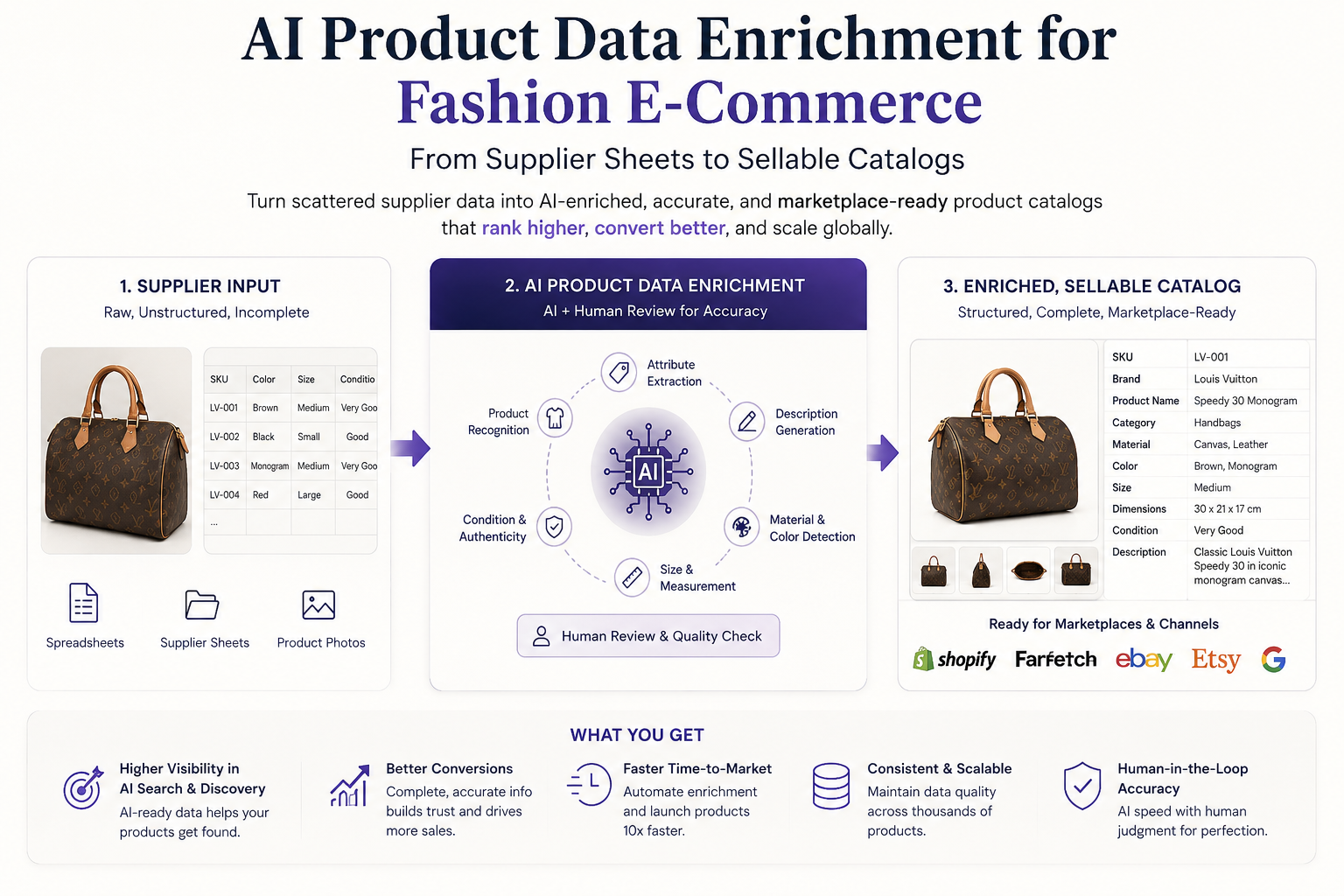
AI product data enrichment is the process of using artificial intelligence, automation, image recognition, natural language processing, and structured workflows to transform incomplete or unstructured product information into complete, accurate, and conversion-ready product data. In fashion e-commerce, this means turning raw supplier sheets, product photos, SKUs, titles, descriptions, categories, attributes, measurements, materials, colors, style tags, and condition notes into a clean product catalog that can perform across your own website, Shopify store, marketplaces, search engines, and AI shopping assistants.
For growing fashion businesses, this is not just a technical improvement. It is a business growth layer.
A better product catalog improves internal operations, speeds up product publishing, reduces human errors, improves search and filtering, supports personalized recommendations, strengthens SEO, prepares your store for AI search, and makes your team more scalable.
At CodeNdCoffee, we work with e-commerce businesses where product data, supplier management, inventory automation, marketplace integrations, and AI-powered catalog workflows are not just “nice to have” features. They are the foundation of a scalable digital commerce operation. [Internal link: E-Commerce Development Services] [Internal link: AI Automation Services] [Internal link: Fashion E-Commerce Solutions]
This article explains what AI product data enrichment is, why it matters for fashion e-commerce, what problems it solves, which keywords and attributes matter most, and how a fashion brand can start building an AI-ready product catalog.
What Is AI Product Data Enrichment?
AI product data enrichment means improving, completing, standardizing, and structuring product information using artificial intelligence and automation.
In a simple fashion e-commerce workflow, a product may start with very limited information:
- SKU
- Supplier name
- One or more product images
- Basic title
- Cost price
- Brand name
- Size
- Category
- Short description
But this is rarely enough for a modern fashion store.
A high-performing product listing often needs much more:
- Standardized product title
- Clean product description
- SEO meta title
- SEO meta description
- Product category
- Subcategory
- Brand
- Designer
- Gender
- Size
- Size type
- Color
- Secondary color
- Material
- Pattern
- Style
- Fit
- Occasion
- Season
- Condition
- Measurements
- Product features
- Care instructions
- Search tags
- Marketplace category mapping
- Google Shopping attributes
- Shopify metafields
- Product schema data
- AI-readable structured attributes
- Internal merchandising tags
- Similar product relations
- Cross-sell and upsell suggestions
AI product data enrichment helps generate, extract, normalize, validate, and organize this information.
For example, if a vintage luxury handbag comes with only a few product images and a supplier title like “LV brown bag medium,” an AI enrichment workflow can help identify or suggest:
- Brand: Louis Vuitton
- Category: Handbag
- Subcategory: Shoulder bag
- Color: Brown
- Pattern: Monogram
- Material: Coated canvas and leather
- Style: Classic, vintage, luxury
- Condition: Requires human review
- Suggested title: Vintage Louis Vuitton Monogram Shoulder Bag
- SEO description: A structured, brand-safe, conversion-focused product description
- Marketplace tags: Luxury handbag, vintage designer bag, monogram shoulder bag
- Internal collection: Vintage luxury handbags
The goal is not to blindly let AI publish everything. The goal is to help your team move faster with better accuracy, better consistency, and better structure.
In fashion e-commerce, AI should assist the catalog team, not replace their judgment.
This is especially important for luxury and vintage products, where condition, authenticity, style, era, material, and small visual details can affect buyer trust and product value.
[Internal link: AI Image Processing Services] [Internal link: Supplier Management Systems]
Why Product Data Is a Growth Problem in Fashion E-Commerce
Many fashion brands think their growth problem is traffic. But often, the real problem is product data.
You can spend money on ads, SEO, influencers, email marketing, and marketplace listings, but if your product data is incomplete, inconsistent, or difficult to search, the business will still leak revenue.
Poor product data creates problems across the full e-commerce funnel.
1. Slow Product Publishing
Fashion businesses often receive products from suppliers in batches. For vintage and resale businesses, every item may be unique. This makes the product listing process even harder.
Your team may need to inspect each product, upload images, write titles, write descriptions, choose categories, select attributes, assign tags, prepare SEO data, and publish to multiple sales channels.
If this is done manually, listing speed becomes a bottleneck.
A slow listing process means products sit in the warehouse or internal system without being available for sale. This directly affects cash flow.
AI product data enrichment can reduce the manual workload by pre-generating titles, descriptions, tags, attributes, and category suggestions. Your team can then review and approve the data instead of starting from zero.
2. Inconsistent Product Titles and Descriptions
One team member may write “Black Leather Shoulder Bag,” another may write “Designer black bag,” and another may write “Women’s luxury leather purse.” All of these may describe a similar product, but the inconsistency creates problems.
Search becomes weaker. Filters become unreliable. SEO becomes fragmented. Marketplace listings become messy. Customers struggle to compare products.
AI enrichment can apply consistent naming rules and brand-specific content guidelines.
For example:
Brand + Product Type + Key Material + Color + Style
This can produce clearer titles like:
“Gucci Black Leather Shoulder Bag”
“Prada Nylon Mini Crossbody Bag”
“Chanel Quilted Lambskin Flap Bag”
“Burberry Vintage Check Wool Scarf”
A consistent title structure improves search, readability, and merchandising.
3. Weak Product Filtering
Fashion buyers often shop by specific preferences:
- Size
- Color
- Brand
- Material
- Style
- Occasion
- Fit
- Condition
- Price
- Pattern
- Season
- Length
- Heel height
- Bag size
- Sleeve type
- Closure type
If your product data does not include these attributes, your filters become weak. Customers cannot narrow down the catalog properly. This creates friction and reduces conversion.
For example, a customer may want:
“Black leather vintage designer handbags under $800”
If your catalog does not have structured values for color, material, condition, category, and price range, your store cannot serve this intent properly.
AI product attribute extraction helps identify these attributes from titles, descriptions, supplier data, and images.
[Internal link: E-Commerce Search and Filtering Solutions]
4. Poor Marketplace Performance
Fashion brands often sell on multiple channels:
- Shopify
- WooCommerce
- Amazon
- eBay
- Etsy
- Farfetch-style marketplaces
- Vestiaire-style marketplaces
- Zalando
- Google Shopping
- Meta catalog
- TikTok Shop
- Custom B2B portals
Each marketplace has different category rules, attribute requirements, title limits, image requirements, and product feed structures.
If your product data is not standardized internally, marketplace integration becomes painful.
AI enrichment can help prepare product data for multiple channels by mapping internal categories and attributes to marketplace-specific requirements.
For example:
Internal category: “Luxury Shoulder Bag”
Shopify category: Apparel & Accessories > Handbags
Google Shopping category: Apparel & Accessories > Handbags, Wallets & Cases > Handbags
Marketplace tag: Designer Shoulder Bags
Internal collection: Vintage Luxury Bags
A structured enrichment layer makes multi-channel selling more scalable.
[Internal link: Marketplace Integration Services] [Internal link: Shopify Development Services]
5. Poor SEO and AI Search Visibility
Traditional SEO still matters, but product discovery is changing. Search engines, AI Overviews, AI shopping assistants, conversational search tools, and recommendation engines increasingly depend on structured, trustworthy, and detailed product information.
If your product pages have thin descriptions, missing attributes, unclear categories, and no structured data, they are harder for both search engines and AI systems to understand.
This is where product enrichment connects directly with SEO and Generative Engine Optimization, also known as GEO.
In the AI search era, your product data needs to answer detailed buyer intent.
For example, not just:
“Designer bag”
But:
“Vintage brown monogram canvas designer shoulder bag for women, medium size, suitable for everyday luxury styling.”
That level of structured meaning helps your products become easier to match with buyer queries.
[Internal link: E-Commerce SEO Services] [Internal link: Generative Engine Optimization Services]
Why Fashion E-Commerce Needs AI Product Data Enrichment More Than Other Categories
Every e-commerce category benefits from clean product data, but fashion has a unique level of complexity.
A phone has technical specifications. A laptop has defined hardware attributes. A skincare product has ingredients and usage instructions. But fashion products are emotional, visual, subjective, seasonal, trend-driven, and highly attribute-dependent.
Fashion buyers search with a mix of practical and emotional intent.
They may search for:
- “minimalist black dress for dinner”
- “vintage designer bag under 1000”
- “oversized wool coat for winter”
- “quiet luxury handbag”
- “Y2K denim mini skirt”
- “brown leather crossbody bag for daily use”
- “formal blazer for office wear”
- “old money style loafers”
- “pre-owned Chanel bag excellent condition”
These searches are not only about category. They include style, occasion, trend, material, condition, aesthetic, and use case.
Most basic e-commerce systems are not designed to understand that.
AI enrichment helps bridge this gap by adding richer context to each product.
For fashion e-commerce, useful enrichment may include:
- Style classification
- Occasion tagging
- Trend mapping
- Visual attribute extraction
- Product similarity
- Outfit compatibility
- Color normalization
- Material detection
- Pattern recognition
- Category correction
- Product title rewriting
- Description generation
- SEO content generation
- Collection assignment
- Cross-sell suggestions
- Condition note formatting
- Luxury resale metadata
For luxury and vintage fashion, enrichment is even more valuable because each product may be one-of-one. Unlike fast fashion, where one product has many units and variants, vintage products often require individual catalog work.
That means automation has a direct impact on productivity.
[Internal link: Luxury Fashion E-Commerce Development] [Internal link: Vintage Fashion E-Commerce Automation]
Key Use Cases of AI Product Data Enrichment in Fashion E-Commerce
AI product data enrichment can support many parts of the product lifecycle. The most valuable use cases are usually found between supplier intake and product publishing.
1. Supplier Data Cleaning
Suppliers often provide product information in different formats. One supplier may send an Excel sheet. Another may send a CSV file. Another may use a shared folder with images. Another may provide only product codes and rough descriptions.
This creates a data normalization problem.
AI and automation can help clean supplier data by:
- Standardizing column names
- Fixing inconsistent brand names
- Normalizing sizes
- Cleaning product titles
- Detecting missing fields
- Removing duplicate values
- Mapping supplier categories to internal categories
- Highlighting products that need manual review
- Translating supplier descriptions
- Reformatting product notes
For example:
Supplier title: “CHNL blk flap used good cond”
Clean title: “Chanel Black Flap Bag – Good Condition”
Suggested category: Handbags > Shoulder Bags
Suggested condition: Good
Missing field: Material requires review
Missing field: Measurements required
This improves the speed and quality of product onboarding.
[Internal link: Supplier Management System Development]
2. Product Attribute Extraction from Images
Fashion images contain valuable product information. A trained AI workflow can help detect or suggest:
- Product type
- Color
- Pattern
- Sleeve length
- Neckline
- Bag shape
- Closure type
- Strap type
- Heel type
- Material appearance
- Logo presence
- Hardware color
- Visual condition signals
- Style category
For example, from a product image, AI may suggest:
Category: Handbag
Subcategory: Tote bag
Primary color: Beige
Secondary color: Brown
Pattern: Monogram
Hardware: Gold-tone
Style: Classic luxury
Suggested tags: designer tote, monogram bag, neutral handbag
For clothing, AI may suggest:
Category: Dress
Length: Midi
Sleeve: Long sleeve
Neckline: V-neck
Pattern: Floral
Occasion: Evening, semi-formal
Season: Spring/Summer
This does not mean the AI should make final decisions for high-value products. Instead, it should pre-fill the likely attributes and allow the catalog team to approve, correct, or reject them.
This is the safest and most practical approach for fashion brands.
[Internal link: AI Image Recognition for E-Commerce]
3. Product Title Generation
Product titles have a major impact on search, filtering, marketplace visibility, and conversion.
A weak title may be:
“Nice bag”
A better title may be:
“Vintage Gucci Brown Monogram Canvas Shoulder Bag”
AI can generate product titles based on rules such as:
Brand + Key Attribute + Material + Product Type + Style
For example:
- “Prada Black Nylon Mini Shoulder Bag”
- “Burberry Beige Check Wool Scarf”
- “Dior Vintage Navy Blue Silk Blouse”
- “Louis Vuitton Monogram Canvas Crossbody Bag”
- “Chanel Quilted Black Leather Wallet on Chain”
Good titles should be clear, searchable, and not overstuffed with keywords.
AI can help maintain consistency across thousands of products while respecting brand tone and marketplace limits.
4. SEO Product Descriptions
Writing descriptions manually for hundreds or thousands of products is time-consuming. But copying supplier descriptions is also risky because they may be incomplete, duplicated, poorly written, or not optimized for search.
AI can generate product descriptions using structured data.
For example, if the system knows:
- Brand
- Category
- Material
- Color
- Size
- Condition
- Measurements
- Style
- Occasion
- Unique features
It can create a clean product description like:
“Add a timeless piece to your collection with this vintage Louis Vuitton monogram shoulder bag. Designed in the brand’s iconic coated canvas with leather trim, this bag offers a classic everyday silhouette with luxury appeal. Its medium size makes it suitable for daily essentials, while the neutral brown monogram pattern pairs easily with casual and elevated outfits.”
The important point is that AI descriptions should be grounded in verified product data. AI should not invent details like authenticity, rarity, exact year, celebrity association, or material unless that information is confirmed.
For luxury fashion, accuracy is more important than creativity.
[Internal link: AI Content Generation for E-Commerce]
5. Category and Taxonomy Mapping
Fashion catalogs need a clear taxonomy.
Without taxonomy, your product catalog becomes messy. You may end up with overlapping categories like:
- Bags
- Handbags
- Ladies Bags
- Designer Bags
- Shoulder Handbags
- Luxury Bags
This confuses customers, admins, and integrations.
AI can help map products into a structured taxonomy:
Apparel
→ Women’s Clothing
→ Dresses
→ Midi Dresses
Accessories
→ Bags
→ Shoulder Bags
→ Designer Shoulder Bags
Shoes
→ Women’s Shoes
→ Heels
→ Slingback Heels
Jewelry
→ Necklaces
→ Pendant Necklaces
A strong taxonomy improves navigation, filtering, SEO, marketplace mapping, and AI-readability.
For Shopify stores, taxonomy and product attributes are especially important because product classification affects search, filtering, merchandising, and channel integrations.
[Internal link: Shopify Product Taxonomy Optimization] [Internal link: E-Commerce Catalog Architecture]
6. Product Tagging and Merchandising
Fashion merchandising depends on more than category.
A product may belong to several merchandising groups:
- New arrivals
- Vintage luxury
- Quiet luxury
- Summer edit
- Wedding guest
- Office wear
- Designer classics
- Under $500
- Excellent condition
- Trending now
- Minimalist style
- Y2K style
- Old money style
AI can suggest merchandising tags based on product attributes and business rules.
For example:
Product: Beige cashmere coat
Tags: winter edit, quiet luxury, minimalist, premium outerwear
Product: Pink mini dress
Tags: partywear, summer edit, evening style
Product: Black Chanel flap bag
Tags: designer classics, investment pieces, luxury handbags
This helps teams create collections faster and improve product discovery.
[Internal link: E-Commerce Merchandising Automation]
7. Marketplace Feed Optimization
Marketplaces require structured product data. Missing or incorrect attributes can cause product rejection, poor visibility, or weak campaign performance.
AI enrichment can help prepare marketplace feeds by:
- Filling missing attributes
- Mapping categories
- Improving titles
- Generating channel-specific descriptions
- Creating ad-friendly product names
- Normalizing sizes and colors
- Adding required feed fields
- Flagging risky or incomplete listings
For example, Google Shopping, Meta catalogs, TikTok Shop, and marketplace platforms all benefit from clean structured data.
Better product feeds can improve ad relevance, product matching, and campaign performance.
[Internal link: Product Feed Management] [Internal link: Marketplace Automation]
8. Internal Search Improvement
Customers often search using natural language. They may not use the exact words in your product title.
A product may be titled:
“Black Quilted Lambskin Flap Bag”
But a customer may search:
“black designer evening bag”
“classic luxury bag”
“small black shoulder bag”
“Chanel-style quilted bag”
If your product data includes richer tags and attributes, your internal search can return better results.
AI enrichment improves search by adding synonyms, style tags, use cases, and structured fields.
This is especially useful for large fashion catalogs where customers need strong search and filtering to find the right product quickly.
[Internal link: E-Commerce Search Solutions]
AI Product Data Enrichment and Generative Engine Optimization
Traditional SEO focuses on ranking in search engine results. Generative Engine Optimization, or GEO, focuses on being visible and recommended inside AI-generated answers, AI shopping assistants, and conversational discovery tools.
This matters because buyers are increasingly using AI tools to research products, compare options, and ask specific shopping questions.
For example:
“What are the best vintage designer handbags under $1,000?”
“What should I wear with a beige cashmere coat?”
“Find me a black leather crossbody bag for everyday use.”
“Which luxury bag styles hold value well?”
“What are good quiet luxury pieces for a capsule wardrobe?”
AI systems need structured, trustworthy, and detailed product information to answer these questions accurately.
If your product pages are thin, generic, or poorly structured, your products are less likely to be understood.
AI product data enrichment supports GEO by improving:
- Product titles
- Product descriptions
- Attribute completeness
- Category clarity
- Product schema
- Internal linking
- Collection pages
- Buying guides
- Comparison content
- FAQs
- Product relationship data
- Review and trust signals
- Human-readable and machine-readable content
For fashion brands, this means product enrichment is no longer only an operations task. It is also part of the visibility strategy.
The future of e-commerce SEO will not be only about keywords. It will be about product meaning.
Search engines and AI assistants need to understand what the product is, who it is for, when it is used, how it compares, what makes it valuable, and whether the information is trustworthy.
[Internal link: Generative Engine Optimization for E-Commerce] [Internal link: E-Commerce SEO Services]
What Product Attributes Should Fashion Brands Enrich?
The right attributes depend on the product type, but most fashion catalogs should consider the following structure.
Core Attributes
These are basic fields every product should have:
- Product title
- SKU
- Brand
- Category
- Subcategory
- Gender
- Size
- Color
- Material
- Price
- Stock status
- Product condition
- Product images
- Description
- SEO title
- SEO meta description
Fashion-Specific Attributes
These attributes improve filtering, personalization, and merchandising:
- Pattern
- Fit
- Style
- Occasion
- Season
- Collection
- Length
- Sleeve length
- Neckline
- Closure type
- Strap type
- Hardware color
- Heel height
- Bag size
- Silhouette
- Fabric type
- Care instructions
- Trend tag
- Aesthetic tag
Luxury and Vintage Attributes
Luxury and vintage products may require deeper enrichment:
- Designer
- Model name
- Serial or authenticity status
- Era or decade
- Condition grade
- Signs of wear
- Inclusions
- Dust bag included
- Box included
- Authentication certificate
- Country of origin
- Measurements
- Rarity level
- Restoration notes
- Comparable style
- Investment-piece tag
For resale businesses, condition attributes are extremely important. Customers want transparency. They need to know if a product has scratches, discoloration, stains, leather wear, hardware fading, missing accessories, or repairs.
AI can assist in condition note formatting, but final condition grading should usually involve human review.
[Internal link: Vintage Fashion Marketplace Development]
SEO and AI-Search Attributes
For SEO and AI visibility, brands should enrich:
- Primary keyword
- Secondary keywords
- Search intent
- Product use cases
- Buyer persona
- Styling suggestions
- FAQs
- Schema markup
- Collection relevance
- Internal link targets
- Related products
- Similar styles
- Alternative names
- Synonyms
- Natural language descriptions
This helps your products appear for broader and more specific search queries.
Example: Before and After AI Product Data Enrichment
Let’s imagine a fashion retailer receives this product from a supplier.
Raw Supplier Data
Title: “Prada bag black used”
Category: “Bag”
Brand: “Prada”
Color: “Black”
Description: “Good condition”
Images: 5 product images
Size: Not provided
Material: Not provided
Tags: None
This data is not enough for a strong listing.
Enriched Product Data
Product title: Prada Black Nylon Shoulder Bag – Pre-Owned
Category: Bags
Subcategory: Shoulder Bags
Brand: Prada
Color: Black
Material: Nylon, leather trim
Style: Minimalist, luxury, everyday
Occasion: Daily wear, travel, casual styling
Condition: Good pre-owned condition
Description: A clean, conversion-focused product description based on verified details
SEO title: Prada Black Nylon Shoulder Bag | Pre-Owned Luxury Fashion
Meta description: Shop a pre-owned Prada black nylon shoulder bag with minimalist luxury appeal. View details, condition notes, and product images.
Tags: Prada bag, black shoulder bag, nylon handbag, pre-owned luxury, everyday designer bag
Collection: Luxury Handbags, New Arrivals, Minimalist Edit
Marketplace category: Apparel & Accessories > Handbags
Internal review required: Confirm measurements and condition details
This enriched version is more useful for:
- Customers
- Admin teams
- Search engines
- Marketplace feeds
- AI shopping assistants
- Paid ads
- Internal search
- Product recommendations
- Merchandising
The product did not change. The data changed.
And better data can create better commercial outcomes.
How AI Product Data Enrichment Improves Conversion Rates
Product enrichment improves conversion because it reduces uncertainty.
Fashion buyers want confidence before purchasing. This is even more important for high-value, pre-owned, vintage, and luxury products.
Better product data helps answer customer questions before they ask:
- What is the material?
- What is the real color?
- What size is it?
- What condition is it in?
- What can I wear it with?
- Is it suitable for daily use?
- Is it formal or casual?
- Is it vintage?
- Is it authentic?
- Does it come with a box or dust bag?
- Are there signs of wear?
- What makes it special?
When these answers are missing, customers hesitate. Hesitation lowers conversion.
AI enrichment helps create more complete product pages by adding the right product details, style context, search tags, and structured content.
However, conversion is not only about writing more content. It is about writing useful content.
A strong enriched product page should include:
- Clear title
- High-quality product images
- Key product attributes
- Short conversion-focused description
- Detailed product information
- Condition notes
- Measurements
- Shipping and return information
- Authenticity or quality assurance details
- Related products
- Styling suggestions
- FAQ section where useful
[Internal link: Conversion Rate Optimization for E-Commerce]
How AI Product Data Enrichment Improves Team Productivity
One of the biggest benefits of AI product data enrichment is operational speed.
Without AI, a catalog team may spend several minutes or even hours preparing a single product, depending on the complexity. For businesses with hundreds or thousands of SKUs, this becomes expensive.
AI can reduce repetitive work by:
- Drafting product titles
- Suggesting categories
- Extracting attributes
- Generating descriptions
- Creating SEO metadata
- Assigning tags
- Mapping marketplace fields
- Detecting missing data
- Highlighting duplicates
- Translating content
- Formatting condition notes
This allows the human team to focus on review, quality control, merchandising decisions, pricing, and brand judgment.
The best workflow is not AI-only. It is human-in-the-loop.
A human-in-the-loop enrichment process may look like this:
- Supplier data is imported.
- Product images are uploaded.
- AI extracts and suggests attributes.
- AI generates title, description, tags, and SEO metadata.
- The system flags missing or uncertain fields.
- A catalog specialist reviews and approves.
- The product is published to the website.
- Marketplace feeds are generated.
- Performance data is tracked.
- The enrichment rules improve over time.
This workflow gives you the speed of AI with the safety of human approval.
[Internal link: Custom E-Commerce Workflow Automation]
How to Build an AI Product Data Enrichment System
A proper AI product data enrichment system is not just a prompt connected to ChatGPT. It requires a structured technical architecture.
A strong system usually includes the following layers.
1. Data Intake Layer
This is where product data enters the system.
Sources may include:
- Supplier CSV files
- Excel sheets
- ERP systems
- Shopify products
- WooCommerce products
- Marketplace exports
- Product images
- Warehouse data
- Internal admin forms
- APIs
- Google Drive or Dropbox folders
- PIM systems
The intake layer should validate and organize incoming data.
[Internal link: ERP Integration Services] [Internal link: Supplier Portal Development]
2. Product Data Model
Before AI can enrich products properly, the business needs a clear product data model.
This means defining:
- Required fields
- Optional fields
- Category structure
- Attribute values
- Brand rules
- Size rules
- Color rules
- Condition grading rules
- Marketplace mapping rules
- SEO rules
- Review workflow
- Approval permissions
Without a clear data model, AI will produce inconsistent results.
AI needs structure to be useful.
[Internal link: E-Commerce Database Architecture]
3. AI Enrichment Layer
This is where AI performs enrichment tasks.
The system may use:
- Large language models for titles, descriptions, metadata, and classification
- Vision models for image attribute extraction
- Embedding models for product similarity
- Rule-based validation for business logic
- Translation models for multilingual catalogs
- Classification models for category mapping
The AI layer should not work randomly. It should follow predefined prompts, rules, examples, brand guidelines, and validation checks.
4. Human Review Layer
For fashion, especially luxury and vintage products, human review is essential.
The review layer allows catalog teams to:
- Approve AI suggestions
- Correct wrong attributes
- Add missing details
- Review condition notes
- Confirm materials
- Validate brand-sensitive claims
- Reject low-confidence suggestions
- Publish approved products
This protects product quality and customer trust.
5. Publishing and Integration Layer
Once product data is approved, it needs to move into sales channels.
This may include:
- Shopify
- WooCommerce
- Custom Laravel store
- Marketplaces
- Google Shopping
- Meta catalog
- TikTok Shop
- Internal ERP
- Warehouse system
- PIM system
- CRM
- BI dashboard
The enrichment system should connect with these platforms through APIs, feeds, or custom integrations.
[Internal link: Shopify API Integration] [Internal link: Laravel E-Commerce Development]
6. Feedback and Performance Layer
A smart enrichment system should learn from business performance.
Useful signals include:
- Product views
- Search terms
- Add-to-cart rate
- Conversion rate
- Return rate
- Time to sell
- Marketplace rejection rate
- Search filter usage
- Customer support questions
- Product recommendation clicks
This data can help improve future enrichment rules.
For example, if products with “quiet luxury” tags perform well, the merchandising team may want to apply similar style tags more consistently.
[Internal link: E-Commerce Analytics Dashboard]
Common Mistakes Fashion Brands Make with AI Product Enrichment
AI product enrichment is powerful, but it must be implemented carefully. Here are common mistakes to avoid.
Mistake 1: Letting AI Invent Product Details
AI should not invent materials, authenticity claims, condition grades, model names, or product history.
For example, if the system is not sure whether a bag is lambskin or calfskin, it should flag the field for review instead of guessing.
Accuracy is critical in fashion, especially luxury resale.
Mistake 2: Using Generic AI Descriptions
Many AI-generated descriptions sound polished but empty.
For example:
“This beautiful bag is perfect for any occasion and will elevate your style.”
This type of content does not add enough value.
Good AI descriptions should be specific, grounded in product data, and aligned with buyer intent.
Mistake 3: Ignoring Taxonomy
If your categories and attributes are messy, AI will not fix everything automatically.
You need a clear taxonomy first.
For example, define whether your system uses:
“Handbag”
“Shoulder Bag”
“Crossbody Bag”
“Tote Bag”
“Clutch Bag”
Each category should have its own expected attributes.
Mistake 4: No Human Review
Fully automated publishing may work for low-risk products, but for luxury and vintage fashion, it can create serious errors.
Human review is important for:
- Condition
- Authenticity
- Material
- Brand-sensitive descriptions
- Measurements
- High-value items
- Marketplace compliance
Mistake 5: Not Connecting Enrichment to Business Goals
AI enrichment should not be treated as an isolated content tool.
It should support clear goals:
- Faster product listing
- Better search
- Better filtering
- Better SEO
- Better marketplace approval
- Better conversion
- Better merchandising
- Better reporting
- Better customer experience
If enrichment is not connected to business outcomes, it becomes another disconnected tool.
AI Product Enrichment for Shopify Fashion Stores
Shopify is one of the most popular platforms for fashion e-commerce, but many Shopify stores still underuse structured product data.
A fashion Shopify store can benefit from AI enrichment through:
- Better product titles
- Better product descriptions
- Shopify metafields
- Product taxonomy mapping
- Collection automation
- Tags and filters
- SEO metadata
- Product feed optimization
- AI-generated image alt text
- Similar product recommendations
- Internal search improvements
- Multilingual product content
Shopify metafields are especially important because they allow brands to store structured product information beyond the basic product fields.
For example, a handbag may have metafields for:
- Material
- Hardware color
- Strap drop
- Width
- Height
- Depth
- Condition grade
- Inclusions
- Authenticity status
- Era
- Style tags
This structured data can then be used on the product page, filters, search, collection rules, marketplace feeds, and AI-powered recommendation systems.
For serious fashion brands, Shopify should not be treated only as a storefront. It should be supported by a strong product data architecture.
[Internal link: Shopify Development Services] [Internal link: Shopify AI Automation]
AI Product Enrichment for Custom E-Commerce Platforms
Not every fashion business should rely only on Shopify. Some brands need custom workflows because their operations are more complex.
A custom Laravel, Vue, React, or Next.js-based platform may be better when the business needs:
- Supplier management
- Product approval workflows
- Custom inventory logic
- Multi-warehouse management
- Marketplace integrations
- Advanced pricing rules
- AI image processing
- Custom product enrichment
- ERP integration
- Internal dashboards
- Role-based team permissions
- Bulk product operations
- Custom reporting
- Forecasting
- B2B portals
For example, a vintage fashion business may need a workflow where products move through stages:
Supplier intake
→ Photography
→ AI attribute extraction
→ Human review
→ Pricing
→ Condition grading
→ Product enrichment
→ Marketplace sync
→ Published
→ Sold
→ Archived
This type of workflow often requires custom software because standard e-commerce platforms may not handle the operational complexity.
[Internal link: Custom E-Commerce Software Development] [Internal link: Laravel Development Services]
How AI Product Enrichment Supports Marketplace Integrations
Marketplace integrations are only as good as the product data behind them.
If your internal catalog is messy, marketplace sync becomes messy.
For example, marketplaces may reject products because of:
- Missing category
- Missing brand
- Missing size
- Invalid color
- Weak title
- Missing image
- Incorrect condition
- Policy-sensitive wording
- Duplicate SKU
- Invalid product type
- Missing required attributes
AI enrichment can reduce these problems by preparing marketplace-ready data before sync.
A good system can create different versions of the same product data for different channels.
For example:
Website title: “Vintage Prada Black Nylon Shoulder Bag”
Google Shopping title: “Prada Black Nylon Shoulder Bag – Pre-Owned Designer Handbag”
Marketplace title: “Pre-Owned Prada Black Nylon Shoulder Bag Good Condition”
Meta catalog title: “Prada Black Nylon Shoulder Bag”
Each channel may need slightly different formatting.
AI can help generate these variations while staying within brand and platform rules.
[Internal link: Marketplace Integration Services] [Internal link: Product Feed Automation]
Measuring the ROI of AI Product Data Enrichment
AI product data enrichment should be measured like a business investment.
Useful metrics include:
Operational Metrics
- Time required to create a product listing
- Number of products listed per day
- Manual data entry hours reduced
- Product approval time
- Number of missing fields per product
- Marketplace rejection rate
- Catalog error rate
SEO and Discovery Metrics
- Organic impressions
- Organic clicks
- Product page rankings
- Collection page rankings
- Internal search success rate
- Search terms with results
- Filter usage
- AI search visibility where measurable
Conversion Metrics
- Product page conversion rate
- Add-to-cart rate
- Revenue per product view
- Time to sell
- Average order value
- Return rate
- Customer support questions per product
Merchandising Metrics
- Collection performance
- Tag-based sales
- Similar product click-through
- Recommended product revenue
- Slow-moving stock visibility
- Stock aging reduction
The goal is to prove that better product data creates better performance.
For many fashion brands, even a small improvement in listing speed, search visibility, or conversion rate can create meaningful revenue impact over time.
[Internal link: E-Commerce KPI Dashboard Development]
Recommended Roadmap for Fashion Brands
If your fashion brand wants to implement AI product data enrichment, do not start with everything at once. Start with the highest-impact workflow.
Phase 1: Audit Your Product Data
Review your current product catalog and identify:
- Missing fields
- Inconsistent titles
- Duplicate categories
- Weak descriptions
- Poor tags
- Missing SEO metadata
- Marketplace errors
- Weak filters
- Manual bottlenecks
This gives you a clear baseline.
Phase 2: Define Your Product Data Model
Create a structured model for:
- Categories
- Attributes
- Required fields
- Optional fields
- Condition grading
- Size normalization
- Color values
- Material values
- SEO rules
- Marketplace rules
This becomes the foundation for AI enrichment.
Phase 3: Start with Semi-Automated Enrichment
Begin with AI-assisted workflows for:
- Product title suggestions
- Description drafts
- Category suggestions
- Attribute extraction
- SEO metadata
- Product tags
Keep human approval in place.
Phase 4: Add Image-Based Attribute Extraction
Use AI image recognition to suggest:
- Color
- Product type
- Pattern
- Style
- Shape
- Visual features
This is especially useful for fashion and luxury products.
Phase 5: Integrate with E-Commerce and Marketplace Systems
Connect enrichment workflows with:
- Shopify
- WooCommerce
- Custom Laravel platforms
- ERP
- Inventory systems
- Marketplace feeds
- Google Shopping
- Meta catalog
Phase 6: Add Analytics and Continuous Improvement
Track the impact on listing speed, SEO, conversion, and marketplace performance.
Use this data to improve prompts, rules, taxonomy, and workflows.
[Internal link: AI Implementation Roadmap for E-Commerce]
Why Work with CodeNdCoffee for AI Product Data Enrichment?
AI product data enrichment is not only a content task. It requires a combination of e-commerce experience, product data architecture, AI integration, workflow automation, marketplace knowledge, and custom software development.
CodeNdCoffee helps e-commerce businesses build practical, scalable, and business-focused technology solutions. Our experience includes custom e-commerce systems, supplier management platforms, inventory workflows, marketplace integrations, AI-powered automation, product catalog management, and analytics dashboards.
For fashion, vintage, luxury, and multi-brand e-commerce businesses, we can help with:
- AI product data enrichment workflows
- Supplier data automation
- Product image attribute extraction
- AI-generated product titles and descriptions
- Shopify metafield architecture
- Custom product catalog systems
- Marketplace feed automation
- Inventory and SKU management
- Product approval workflows
- AI-assisted merchandising
- E-commerce analytics dashboards
- Custom Laravel, Vue, React, and Next.js development
- Shopify and WooCommerce integrations
[Internal link: About CodeNdCoffee] [Internal link: E-Commerce Development Services] [Internal link: AI Automation Services] [Internal link: Contact Us]
Our approach is practical. We do not recommend AI just because it is trending. We look at your current workflow, identify bottlenecks, design the right data structure, and build automation that helps your team save time, reduce errors, and grow revenue.
For many fashion businesses, the biggest opportunity is not replacing people with AI. It is giving the team better systems so they can publish faster, merchandise smarter, and make better decisions.
Final Thoughts
Fashion e-commerce is becoming more data-driven, more automated, and more AI-assisted. But AI cannot create value from messy, incomplete, and disconnected product data.
If your product catalog is inconsistent, your filters are weak, your marketplace feeds are difficult to manage, and your team spends too much time preparing listings manually, AI product data enrichment can become a major competitive advantage.
The brands that invest in structured product data today will be better prepared for:
- AI shopping assistants
- Generative search
- Personalized recommendations
- Marketplace growth
- Faster product publishing
- Better SEO
- Better customer experience
- Smarter merchandising
- Scalable e-commerce operations
For fashion brands, especially luxury, vintage, resale, and multi-brand retailers, the future belongs to businesses that can turn raw product information into intelligent, structured, and conversion-ready product data.
AI product data enrichment is not just about better descriptions.
It is about building an AI-ready commerce foundation.
If your fashion e-commerce business is ready to improve product data, automate catalog workflows, and build a scalable AI-powered e-commerce system, CodeNdCoffee can help you design and develop the right solution.
[Internal link: Contact CodeNdCoffee] [Internal link: Book a Consultation] [Internal link: AI Automation Services]
Enjoyed this article?
Share it with your network