
AI Agents for E-Commerce Operations
How AI Agents Can Automate Customer Support, Inventory, Product Data, Order Workflows, and Growth Operations E-commerce is becoming more complex every year. Brands are selling across multiple channels, managing larger product catalogs, dealing with rising customer…

- 30 Min Read
- Feb 17, 2026
- 6 Views
- How AI Agents Can Automate Customer Support, Inventory, Product Data, Order Workflows, and Growth Operations
- What Are AI Agents in E-Commerce?
- Why AI Agents Matter for E-Commerce Operations
- AI Agents vs Traditional Automation
- Key Use Cases of AI Agents for E-Commerce Operations
- 1. AI Customer Support Agent
- 2. AI Product Catalog Agent
- 3. AI Inventory Monitoring Agent
- 4. AI Supplier Management Agent
- 5. AI Order Management Agent
- 6. AI Returns and Exchanges Agent
- 7. AI Marketplace Operations Agent
- 8. AI Marketing Operations Agent
- 9. AI Analytics and Reporting Agent
- 10. AI Merchandising Agent
- AI Agents for Fashion and Luxury E-Commerce
- AI Agents for Shopify Stores
- AI Agents for Custom E-Commerce Platforms
- How AI Agents Actually Work in an E-Commerce System
- 1. Business Data Access
- 2. Tool Access
- 3. Business Rules
- 4. Knowledge Base
- 5. Human Approval Layer
- 6. Audit Logs
- Human-in-the-Loop AI: The Safest Model for E-Commerce
- Common Mistakes Businesses Make with AI Agents
- Mistake 1: Starting Without Clean Data
- Mistake 2: Giving the Agent Too Much Control Too Early
- Mistake 3: No Clear Escalation Rules
- Mistake 4: Using Generic AI Tools Without Integration
- Mistake 5: Not Measuring Results
- How to Start Implementing AI Agents in E-Commerce
- Phase 1: Identify Operational Bottlenecks
- Phase 2: Prepare Data and Policies
- Phase 3: Start with an Internal Assistant
- Phase 4: Add Human Approval Workflows
- Phase 5: Connect More Systems
- Phase 6: Expand Agent Capabilities
- Example AI Agent Workflow for a Fashion E-Commerce Brand
- AI Supplier Agent
- AI Catalog Agent
- AI Inventory Agent
- AI Marketplace Agent
- AI Marketing Agent
- Human Team
- AI Agents and the Future of Agentic Commerce
- Security and Risk Considerations
- Measuring ROI from AI Agents
- Customer Support Metrics
- Inventory Metrics
- Catalog Metrics
- Order Operations Metrics
- Marketing Metrics
- Management Metrics
- Why Work with CodeNdCoffee for E-Commerce AI Agents?
- Final Thoughts
How AI Agents Can Automate Customer Support, Inventory, Product Data, Order Workflows, and Growth Operations
E-commerce is becoming more complex every year. Brands are selling across multiple channels, managing larger product catalogs, dealing with rising customer expectations, operating with leaner teams, and trying to stay competitive in a market where speed, personalization, and operational efficiency matter more than ever.
For many e-commerce businesses, the biggest growth problem is no longer just launching a store. The real challenge is running the operation behind the store.
A modern e-commerce business may need to manage products, inventory, suppliers, purchase orders, customer support, returns, marketplace listings, product feeds, pricing, email campaigns, analytics, customer segmentation, reviews, fulfillment, and reporting — often across multiple platforms.
This creates a major operational burden.
Teams spend hours answering repetitive questions, checking stock levels, updating product information, preparing reports, following up with customers, fixing marketplace errors, reviewing orders, managing returns, and coordinating between departments. As the business grows, these small tasks become expensive bottlenecks.
This is where AI agents for e-commerce operations become valuable.
An AI agent is not just a chatbot. A chatbot usually responds to user questions. An AI agent can understand a goal, read data, use tools, follow rules, make recommendations, trigger workflows, and assist humans in completing operational tasks.
In e-commerce, AI agents can help with customer support, product catalog management, supplier communication, inventory monitoring, order management, returns, marketing operations, reporting, marketplace optimization, and internal team productivity.
The goal is not to replace the entire e-commerce team. The goal is to give the team intelligent assistants that can reduce repetitive work, detect problems earlier, improve decision-making, and speed up daily operations.
For CodeNdCoffee, AI agents fit naturally into our e-commerce development, marketplace integration, supplier management, inventory automation, product data enrichment, and custom software development services. [Internal link: E-Commerce Development Services] [Internal link: AI Automation Services] [Internal link: AI Agents Development]
This article explains what AI agents are, how they work in e-commerce operations, which use cases matter most, how to implement them safely, and how growing e-commerce brands can prepare their systems for agentic commerce.
What Are AI Agents in E-Commerce?
AI agents are software-based assistants that use artificial intelligence to perform tasks, make decisions, or support workflows on behalf of a user, team, or business.
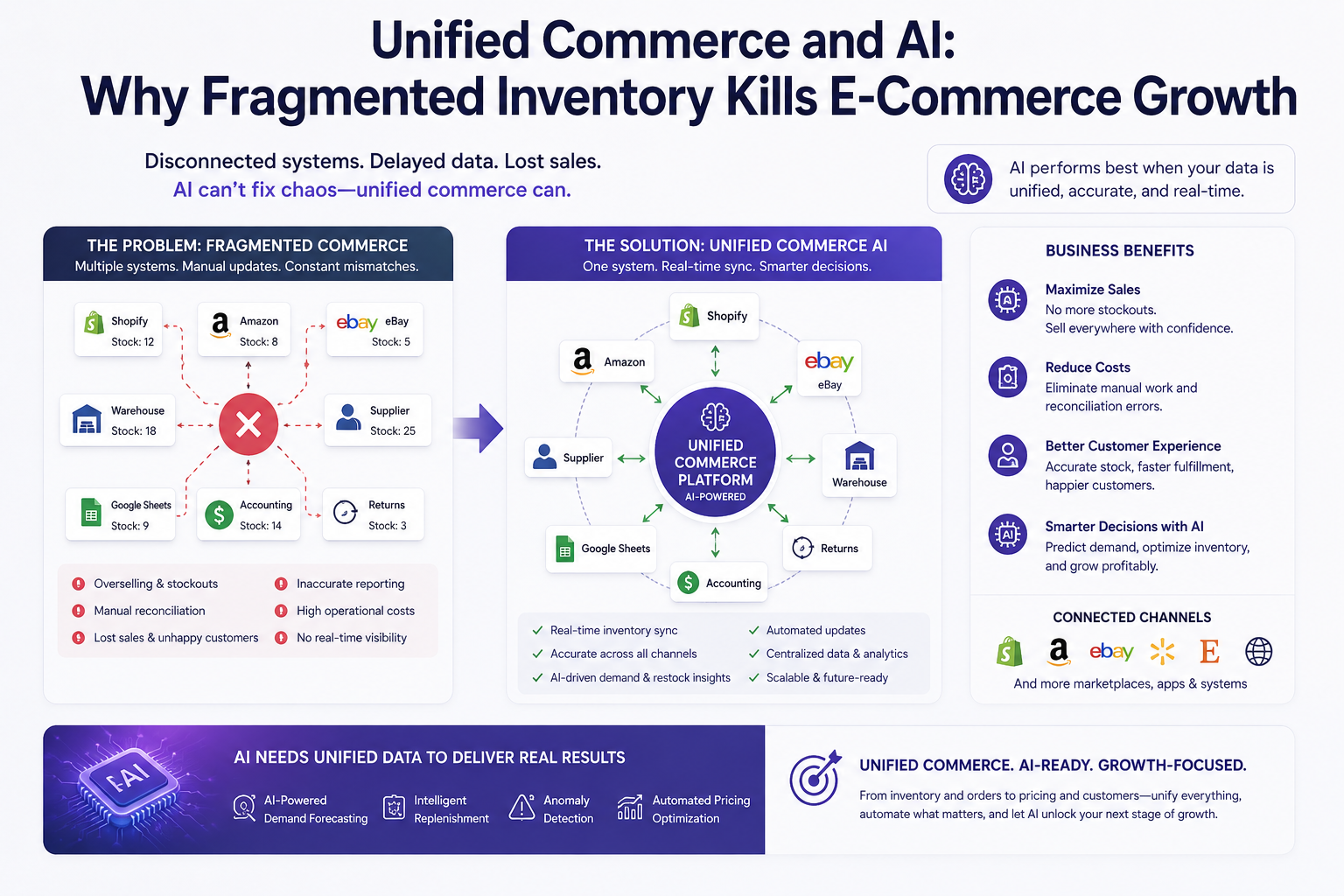
In e-commerce, an AI agent may be connected to your store, product catalog, inventory system, CRM, order management system, helpdesk, marketplace accounts, analytics tools, email platform, or internal admin dashboard.
Instead of only answering a simple question, an AI agent can perform multi-step work.
For example, a customer support chatbot might answer:
“Your order is on the way.”
But an AI customer support agent can:
-
Understand the customer’s message.
-
Identify the customer.
-
Check the order status.
-
Read the shipping information.
-
Check the return policy.
-
Draft a personalized response.
-
Offer next steps.
-
Escalate the case if the issue is complex.
-
Add a note to the CRM.
-
Tag the conversation for reporting.
That is the difference between a basic chatbot and an operational AI agent.
In e-commerce operations, AI agents can be designed for different departments:
-
Customer support agent
-
Inventory monitoring agent
-
Product catalog agent
-
Supplier communication agent
-
Order management agent
-
Returns management agent
-
Marketplace listing agent
-
Marketing operations agent
-
Pricing intelligence agent
-
Analytics and reporting agent
-
Merchandising assistant agent
-
Internal team assistant agent
Each agent has a specific role, tools, permissions, and rules.
The best e-commerce AI agents do not operate randomly. They follow your business logic, policies, workflows, approval rules, and data structure.
Why AI Agents Matter for E-Commerce Operations
E-commerce brands are under pressure from multiple directions.
Customers expect faster replies. Marketplaces expect clean product data. Paid advertising is becoming more expensive. Inventory mistakes hurt profit. Returns create operational load. Product content needs to be optimized for search, marketplaces, and AI discovery. Teams need better reporting. Business owners need faster decisions.
At the same time, hiring more people for every operational problem is not always sustainable.
AI agents help e-commerce brands scale operations without scaling manual work at the same rate.
They can help businesses:
-
Reduce repetitive admin tasks
-
Improve customer response speed
-
Detect inventory risks earlier
-
Automate product data workflows
-
Improve internal reporting
-
Reduce manual order checking
-
Improve marketplace listing quality
-
Support team members with recommendations
-
Create better customer experiences
-
Improve operational visibility
-
Make better use of existing business data
The value of AI agents is not only automation. It is operational intelligence.
A normal automation rule might say:
“If stock is below 5, send alert.”
An AI inventory agent can go further:
“Stock is below 5, sales velocity has increased over the last 14 days, supplier lead time is 12 days, and this product is part of an active campaign. Recommended action: reorder 50 units or pause ads if reorder is not possible.”
That is more useful than a basic alert.
AI agents are valuable because they combine automation, reasoning, data access, and workflow execution.
AI Agents vs Traditional Automation
Many e-commerce businesses already use automation.
For example:
-
Send an email when an order is placed.
-
Reduce stock when a product is sold.
-
Create a shipping label after payment.
-
Send a reminder when payment fails.
-
Add a customer to an email segment after purchase.
-
Notify the team when a product goes out of stock.
These automations are useful, but they are usually rule-based. They work well when the situation is simple and predictable.
AI agents are different because they can handle more complex, context-based tasks.
A traditional automation follows fixed rules.
An AI agent can:
-
Read unstructured messages
-
Understand customer intent
-
Summarize data
-
Compare options
-
Make recommendations
-
Detect anomalies
-
Use multiple tools
-
Ask for human approval
-
Learn from previous decisions
-
Handle exceptions more intelligently
For example, a traditional automation may not understand this customer message:
“Hi, I ordered a black medium dress last week, but I just saw another one that looks better for a wedding. Can I exchange it before Saturday?”
An AI support agent can understand that this is not just a return request. It includes order lookup, product comparison, delivery timeline, exchange policy, and urgency.
Similarly, a traditional inventory alert may only show low stock. An AI inventory agent can consider sales trends, supplier lead time, seasonal demand, pending purchase orders, and current campaigns.
This does not mean traditional automation is outdated. In fact, the best systems combine both.
Traditional automation should handle predictable actions. AI agents should handle context, judgment support, and complex workflows.
Key Use Cases of AI Agents for E-Commerce Operations
AI agents can support many parts of an e-commerce business. The best starting point depends on where the business has the highest manual workload, highest error rate, or biggest revenue leakage.
Below are the most practical and high-value use cases.
1. AI Customer Support Agent
Customer support is one of the easiest and most valuable areas to start with AI agents.
E-commerce support teams often answer repetitive questions:
-
Where is my order?
-
Can I return this product?
-
What size should I choose?
-
Is this product available?
-
When will this item be restocked?
-
Can I change my delivery address?
-
What payment methods do you accept?
-
Do you ship internationally?
-
Is this product authentic?
-
How do I exchange an item?
A basic chatbot can answer FAQs, but an AI customer support agent can do much more.
It can connect with:
-
Order management system
-
Shipping provider
-
Product catalog
-
Inventory system
-
Return policy
-
Customer profile
-
CRM
-
Helpdesk
-
Email system
-
WhatsApp or live chat
This allows the agent to provide context-aware answers.
For example:
Customer: “Where is my order?”
AI agent workflow:
-
Identify the customer.
-
Find the latest order.
-
Check fulfillment status.
-
Read tracking information.
-
Detect delivery delay if any.
-
Explain the status in simple language.
-
Offer next steps.
-
Escalate to human support if required.
For fashion e-commerce, the support agent can also help with:
-
Size guidance
-
Product recommendations
-
Styling questions
-
Return eligibility
-
Condition questions for pre-owned items
-
Shipping restrictions
-
Authenticity-related FAQs
-
Product availability
-
Similar product suggestions
However, AI support agents should have boundaries. They should not promise refunds, approve high-value returns, make legal claims, or guarantee authenticity unless the system has verified data and the business has approved that workflow.
A safe AI support agent should know when to escalate to a human.
2. AI Product Catalog Agent
Product catalog management is one of the biggest operational challenges in e-commerce, especially for fashion, luxury, vintage, beauty, furniture, and multi-brand stores.
A product catalog agent can help teams manage product information faster and more consistently.
It can assist with:
-
Product title generation
-
Product description drafting
-
Attribute extraction
-
Category mapping
-
Tag suggestions
-
SEO metadata
-
Image alt text
-
Shopify metafields
-
Marketplace descriptions
-
Product feed validation
-
Missing field detection
-
Duplicate product detection
-
Product quality checks
For example, when a new product is added, the AI catalog agent can review the product and say:
“This product is missing material, size guide data, image alt text, SEO meta description, and marketplace category mapping. Suggested title: Vintage Gucci Brown Leather Shoulder Bag. Suggested tags: vintage Gucci, brown leather bag, luxury shoulder bag, pre-owned designer handbag.”
This saves the catalog team from starting manually.
For fashion e-commerce, a catalog agent can work together with product data enrichment workflows.
[Internal link: AI Product Data Enrichment] [Internal link: Fashion E-Commerce Solutions]
A catalog agent can also help maintain consistency across the store.
For example, if one product uses “navy,” another uses “dark blue,” and another uses “midnight blue,” the agent can suggest standardized color values. This improves filters, search, and marketplace feeds.
For growing e-commerce brands, product catalog agents are especially useful because catalog quality directly affects conversion, search visibility, and customer experience.
3. AI Inventory Monitoring Agent
Inventory is one of the most important areas in e-commerce operations.
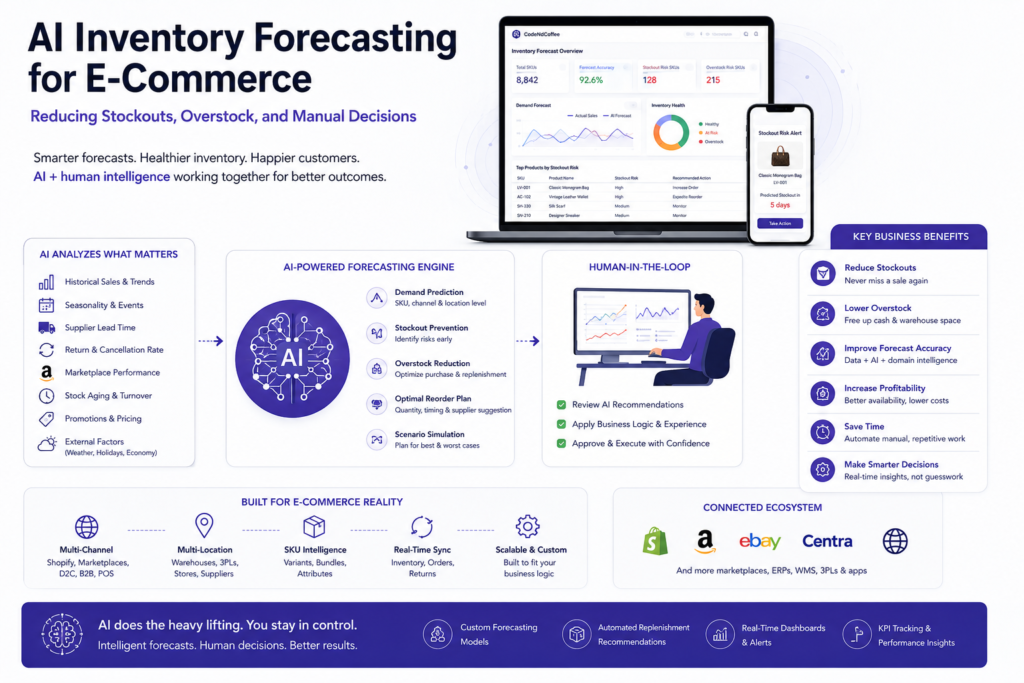
Too much stock creates cash flow problems. Too little stock creates lost sales. Wrong stock creates customer complaints. Slow-moving stock reduces profitability. Manual stock checks waste time.
An AI inventory monitoring agent can help by continuously reviewing inventory data and highlighting risks.
It can monitor:
-
Current stock
-
Sales velocity
-
Stock aging
-
Supplier lead time
-
Pending purchase orders
-
Return rates
-
Seasonal demand
-
Campaign schedules
-
Marketplace performance
-
Warehouse stock
-
Reserved stock
-
Damaged stock
-
Stock transfers
Instead of only showing raw numbers, the agent can provide useful recommendations.
For example:
“Product A has 8 units left, but the average daily sales rate increased from 1.2 to 3.4 units after the latest campaign. Supplier lead time is 14 days. Recommended action: reorder within 48 hours or reduce campaign budget to avoid stockout.”
Another example:
“Product B has 120 units in stock but only sold 4 units in the last 60 days. It may become slow-moving inventory. Recommended action: add to discount campaign, feature in collection, or bundle with related products.”
An AI inventory agent can also help identify:
-
Overstock risk
-
Stockout risk
-
Dead stock
-
Fast-moving products
-
Supplier delays
-
Forecasting issues
-
Products with high return rates
-
Products with inventory mismatches
-
Products that should be reordered
-
Products that should be discounted
This kind of agent should not always place purchase orders automatically. For most businesses, a human approval step is safer.
The recommended workflow is:
AI detects risk
→ AI explains reason
→ AI suggests action
→ Manager approves
→ System creates purchase order or task
This human-in-the-loop model keeps control with the business while reducing manual analysis.
4. AI Supplier Management Agent
Supplier coordination is a hidden operational burden in many e-commerce businesses.
Teams often need to communicate with suppliers about:
-
Product availability
-
Purchase orders
-
Delivery timelines
-
Cost changes
-
Missing product data
-
Damaged goods
-
Return to supplier
-
Product images
-
SKU mismatches
-
Stock updates
-
Invoices
-
Lead times
-
Delayed shipments
An AI supplier management agent can help organize and automate parts of this communication.
It can:
-
Draft supplier emails
-
Summarize supplier replies
-
Extract delivery dates
-
Detect missing documents
-
Match supplier SKUs with internal SKUs
-
Flag cost price changes
-
Track supplier response delays
-
Create internal tasks
-
Update purchase order notes
-
Prepare supplier performance summaries
For example:
Supplier email: “We can ship 60 pieces this Friday, but the remaining 40 will be delayed until next week.”
AI agent output:
“PO #4587 is partially available. 60 units can ship on Friday. 40 units delayed until next week. Recommended action: update expected delivery date, notify inventory team, and adjust availability forecast.”
This is especially useful for businesses with multiple suppliers, international sourcing, or frequent product intake.
For vintage and luxury fashion businesses, suppliers may send inconsistent product data. An AI supplier agent can work with the catalog agent to detect missing attributes before products enter the listing workflow.
5. AI Order Management Agent
Order operations can become complicated as sales channels increase.
A business may receive orders from:
-
Shopify
-
WooCommerce
-
Amazon
-
eBay
-
Etsy
-
TikTok Shop
-
Instagram Shop
-
Custom marketplace
-
B2B portal
-
Manual invoice orders
An AI order management agent can help monitor order workflows and detect problems.
It can identify:
-
Unfulfilled orders
-
Delayed shipments
-
High-risk orders
-
Duplicate orders
-
Payment issues
-
Address issues
-
Fraud signals
-
Shipping exceptions
-
Orders stuck in processing
-
Orders waiting for stock
-
Orders with customer notes
-
Orders needing manual review
For example:
“Order #10982 has been paid but not fulfilled after 48 hours. The product is available in warehouse B, but the order was assigned to warehouse A. Recommended action: reassign fulfillment location or create transfer request.”
Another example:
“Order #11035 contains a high-value product and the shipping address differs from billing country. Recommended action: send for manual fraud review before fulfillment.”
AI order agents are useful because many order issues are not obvious from a dashboard. They require context across payment, inventory, fulfillment, customer history, and shipping data.
The agent can act as an operations watchdog.
6. AI Returns and Exchanges Agent
Returns are a major part of e-commerce operations, especially in fashion.
Customers may return items because of:
-
Size issues
-
Color mismatch
-
Product not as expected
-
Damaged item
-
Late delivery
-
Wrong item received
-
Change of mind
-
Quality concerns
-
Fit problems
-
Condition disagreement
A returns agent can help automate the first layer of return handling.
It can:
-
Read the return request
-
Check return eligibility
-
Verify order date
-
Check product category rules
-
Review product condition policy
-
Suggest refund, exchange, or store credit
-
Generate return instructions
-
Create return labels where allowed
-
Flag complex cases for human review
-
Summarize return reasons
-
Identify products with high return rates
For fashion brands, return data is extremely valuable.
If many customers return a product because it runs small, the business may need to update the size guide or product description.
If many customers return a product due to color mismatch, the brand may need better images or more accurate color naming.
If a pre-owned product is returned because of condition expectations, the business may need clearer condition grading.
An AI returns agent can convert return conversations into operational insights.
7. AI Marketplace Operations Agent
Selling on marketplaces can increase revenue, but it also increases operational complexity.
Marketplaces often have strict rules around:
-
Product titles
-
Categories
-
Required attributes
-
Image requirements
-
Pricing
-
Stock sync
-
Shipping times
-
Return policies
-
Brand restrictions
-
Product condition
-
Feed formatting
An AI marketplace operations agent can help identify listing issues before they become lost sales.
It can:
-
Review product feed errors
-
Suggest missing attributes
-
Rewrite marketplace titles
-
Map internal categories to marketplace categories
-
Detect rejected listings
-
Compare marketplace performance
-
Monitor stock sync issues
-
Flag pricing conflicts
-
Summarize marketplace policy issues
-
Create tasks for the catalog team
For example:
“17 products were rejected on Marketplace A due to missing material and invalid color values. Suggested fix: map ‘golden’ to ‘gold,’ add material field from product description, and resubmit feed.”
This type of agent is valuable for brands selling across Shopify, Google Shopping, Meta catalog, Amazon, eBay, Etsy, or niche marketplaces.
8. AI Marketing Operations Agent
Marketing teams also spend a lot of time on repetitive tasks.
An AI marketing operations agent can help with:
-
Email campaign drafts
-
Customer segmentation
-
Abandoned cart messaging
-
Product recommendation blocks
-
Campaign performance summaries
-
Social post drafts
-
Ad copy variations
-
Landing page content
-
SEO briefs
-
Blog topic suggestions
-
Product launch campaigns
-
Discount campaign planning
For example, the agent can review sales data and suggest:
“Customers who bought designer shoulder bags in the last 90 days may be interested in the new luxury wallet collection. Suggested campaign: cross-sell wallets with a limited-time free shipping offer.”
Another example:
“The winter coats collection has high product views but low conversion. Suggested actions: improve size guide, add model photos, test 10% discount, and update product descriptions with material and warmth details.”
Marketing agents become more useful when connected to product, order, customer, and inventory data.
Without data integration, AI marketing remains generic.
With data integration, it becomes personalized and operationally aware.
9. AI Analytics and Reporting Agent
Many e-commerce businesses have data, but not enough insight.
Data may exist across:
-
Shopify reports
-
Google Analytics
-
Search Console
-
Marketplace dashboards
-
ERP
-
Inventory system
-
CRM
-
Email marketing tools
-
Ad platforms
-
Customer support tools
-
Accounting systems
A business owner or manager may need to check multiple dashboards to answer simple questions:
-
What products are selling fastest?
-
Which products are stuck?
-
Which channels are most profitable?
-
Which products have high returns?
-
Which campaigns generated real profit?
-
Which suppliers are delayed?
-
Which categories are growing?
-
Which products need restocking?
-
Which customer segments are most valuable?
An AI reporting agent can help by turning scattered data into simple business summaries.
For example:
“Last week, revenue increased by 12%, but gross margin decreased by 4% because discounted products represented 38% of sales. The handbag category performed best, while shoes had the highest return rate. Three products are at stockout risk within 7 days.”
This is much more useful than a static dashboard.
The agent can also answer natural language questions:
“Which products should we reorder this week?”
“Which category had the best margin last month?”
“Which products are selling well but have low stock?”
“Which supplier caused the most delays?”
“Which products had high traffic but low conversion?”
AI reporting agents can make e-commerce data more accessible to founders, managers, and non-technical teams.
10. AI Merchandising Agent
Merchandising is where product data, customer behavior, inventory, and brand strategy meet.
An AI merchandising agent can help teams decide:
-
Which products to feature
-
Which products to discount
-
Which collections to create
-
Which products to recommend together
-
Which products are trending
-
Which products need better visibility
-
Which slow-moving products need promotion
-
Which new arrivals should be highlighted
-
Which seasonal products should move up
For fashion e-commerce, merchandising is especially important because customers shop by style, occasion, mood, and trend.
An AI merchandising agent can suggest collections such as:
-
Quiet Luxury Edit
-
Wedding Guest Dresses
-
Vintage Designer Bags
-
Office Essentials
-
Winter Coats
-
Under $500 Luxury Finds
-
Minimalist Wardrobe
-
Evening Accessories
-
New Season Neutrals
It can also recommend product placements based on:
-
Stock levels
-
Product views
-
Add-to-cart rate
-
Conversion rate
-
Margin
-
Seasonality
-
Customer behavior
-
Return rate
-
Product age
-
Similar product performance
For example:
“Move Product A higher in the New Arrivals collection. It has a 9% add-to-cart rate, strong margin, and sufficient stock. Product B has high views but low conversion, so it may need better images or pricing review.”
This helps merchandising teams make faster, data-informed decisions.
AI Agents for Fashion and Luxury E-Commerce
Fashion and luxury e-commerce have unique operational needs.
Unlike simple commodity products, fashion products are highly visual, subjective, and attribute-driven. Luxury and vintage products often require deeper review, condition details, authenticity-related information, and rich product storytelling.
AI agents can help fashion businesses with:
-
Product attribute extraction
-
Size and fit guidance
-
Style recommendations
-
Condition note formatting
-
Product description generation
-
Collection tagging
-
Similar product matching
-
Luxury product metadata
-
Supplier intake workflows
-
Marketplace listing preparation
-
Customer support questions
-
Returns reason analysis
-
Visual search support
-
Styling assistant workflows
For example, a fashion AI agent can help a customer ask:
“I need a black designer bag for evening events under $900.”
The agent can search the catalog, filter by category, price, color, condition, style, and availability, then recommend suitable products.
For internal teams, the agent can say:
“These five newly uploaded products are missing material and measurements. Three appear to be shoulder bags based on images. Two need manual review because the brand name is uncertain.”
This kind of AI support can reduce manual work while improving product quality.
For luxury brands, tone and trust are critical. AI should not make exaggerated claims, invent authenticity details, or use low-quality generic descriptions.
The agent should follow brand voice, compliance rules, and approval workflows.
AI Agents for Shopify Stores
Shopify stores can benefit significantly from AI agents, especially when the store has many products, multiple apps, and growing order volume.
A Shopify AI agent can connect with:
-
Products
-
Orders
-
Customers
-
Inventory
-
Collections
-
Metafields
-
Discounts
-
Shopify Flow
-
Shopify Inbox
-
Email tools
-
Helpdesk tools
-
Fulfillment apps
-
Marketplace apps
-
Analytics tools
Useful Shopify AI agent workflows include:
-
Answer customer questions using product and order data
-
Suggest product descriptions
-
Fill missing metafields
-
Detect low-stock products
-
Recommend products for collections
-
Draft abandoned cart campaigns
-
Summarize weekly store performance
-
Review products with missing SEO fields
-
Identify slow-moving inventory
-
Suggest reorder actions
-
Detect products with high returns
-
Prepare product feed improvements
For example:
“Show me products with high views but low conversion.”
The AI agent can review analytics and product data, then suggest:
-
Improve product images
-
Add size guide
-
Rewrite description
-
Adjust price
-
Add reviews
-
Add product video
-
Improve shipping information
-
Add related products
Shopify is powerful, but many stores use it only as a product and order system. AI agents can turn Shopify into a more intelligent operations hub when connected properly.
AI Agents for Custom E-Commerce Platforms
Some e-commerce businesses need more than a standard Shopify setup.
They may need custom platforms because they have:
-
Complex supplier workflows
-
Custom product approval stages
-
Multi-warehouse inventory
-
Marketplace integrations
-
B2B pricing
-
Custom order workflows
-
Internal ERP requirements
-
AI image processing
-
Forecasting systems
-
Custom dashboards
-
Role-based operations
-
Advanced reporting
-
Unique business logic
For these businesses, AI agents can be built directly into the custom platform.
A custom e-commerce AI agent can access business-specific data and workflows more deeply than a generic tool.
For example, in a custom Laravel and Vue platform, an AI operations agent may:
-
Read supplier purchase orders
-
Monitor product intake status
-
Check photography progress
-
Suggest product attributes
-
Flag missing catalog fields
-
Review inventory transactions
-
Summarize daily operations
-
Create tasks for team members
-
Detect delayed SKUs
-
Generate management reports
-
Recommend reorder quantities
-
Prepare marketplace sync suggestions
Custom AI agents are especially useful when the business has operational complexity that standard SaaS tools cannot fully support.
How AI Agents Actually Work in an E-Commerce System
A useful e-commerce AI agent needs more than a chat interface.
It usually requires several technical components.
1. Business Data Access
The agent needs access to relevant data, such as:
-
Products
-
Orders
-
Customers
-
Inventory
-
Suppliers
-
Returns
-
Reviews
-
Analytics
-
Campaigns
-
Marketplace feeds
-
Policies
-
Documentation
Without data access, the agent can only give generic answers.
2. Tool Access
The agent may need to use tools or APIs.
For example:
-
Search products
-
Check order status
-
Create support ticket
-
Update product field
-
Draft email
-
Create task
-
Generate report
-
Check stock
-
Create purchase order draft
-
Send notification
-
Update CRM note
Tool access should be controlled carefully.
Not every agent should be allowed to perform every action.
3. Business Rules
The agent needs clear rules.
For example:
-
Do not approve refunds above a certain amount.
-
Do not change prices without approval.
-
Do not publish product descriptions without review.
-
Do not promise delivery dates unless confirmed.
-
Do not make authenticity claims unless verified.
-
Escalate angry customers to human support.
-
Ask for approval before creating purchase orders.
-
Flag uncertain product attributes for review.
Rules protect the business from AI mistakes.
4. Knowledge Base
The agent should understand company policies and documentation.
This may include:
-
Return policy
-
Shipping policy
-
Size guide
-
Supplier rules
-
Marketplace guidelines
-
Product description rules
-
Brand tone guidelines
-
Internal SOPs
-
Customer service scripts
-
Inventory rules
-
Escalation rules
This helps the agent respond consistently.
5. Human Approval Layer
The most important layer is human approval.
For sensitive actions, the agent should recommend, not execute.
Human approval should be required for:
-
Refunds
-
Returns outside policy
-
Price changes
-
High-value orders
-
Purchase orders
-
Supplier disputes
-
Product publishing
-
Luxury product claims
-
Marketplace-sensitive changes
-
Customer compensation
AI agents should increase speed without removing control.
6. Audit Logs
Every agent action should be logged.
The system should record:
-
What the agent suggested
-
What data it used
-
Who approved the action
-
What action was taken
-
When it happened
-
Whether the result was successful
Audit logs are important for trust, debugging, accountability, and process improvement.
Human-in-the-Loop AI: The Safest Model for E-Commerce
There is a lot of hype around fully autonomous AI agents. But for most e-commerce businesses, full autonomy is not the safest starting point.
A better model is human-in-the-loop AI.
This means AI agents can analyze, suggest, draft, and prepare actions, but humans approve important decisions.
For example:
AI should be able to:
-
Draft customer replies
-
Suggest reorder quantities
-
Flag suspicious orders
-
Recommend product tags
-
Summarize supplier emails
-
Draft product descriptions
-
Identify return trends
-
Highlight marketplace errors
-
Generate reports
But humans should approve:
-
Refunds
-
Legal-sensitive replies
-
Supplier negotiations
-
Purchase orders
-
Product publishing
-
Price changes
-
High-value order decisions
-
Final condition grading
-
Brand-sensitive messaging
This model is practical because it keeps human judgment in the business while allowing AI to remove repetitive work.
For growing brands, this is the best balance between productivity and control.
Common Mistakes Businesses Make with AI Agents
AI agents can be powerful, but they can also create problems if implemented incorrectly.
Mistake 1: Starting Without Clean Data
AI agents are only as good as the data they can access.
If your product catalog is messy, order data is incomplete, inventory is inaccurate, and policies are unclear, the agent will struggle.
Before implementing AI agents, businesses should clean and structure their data.
Mistake 2: Giving the Agent Too Much Control Too Early
Many businesses get excited and want AI to automate everything.
This is risky.
Start with low-risk workflows:
-
Drafting replies
-
Summarizing reports
-
Flagging issues
-
Suggesting tags
-
Creating tasks
-
Preparing recommendations
Then gradually move toward controlled execution with approval.
Mistake 3: No Clear Escalation Rules
An AI agent should know when to stop and escalate.
Escalation should happen when:
-
Customer is angry
-
Refund is high value
-
Product claim is sensitive
-
Order is suspicious
-
Policy is unclear
-
AI confidence is low
-
Supplier dispute exists
-
Legal or compliance issue appears
Without escalation rules, the agent may create poor customer experiences.
Mistake 4: Using Generic AI Tools Without Integration
Generic AI tools can help with writing, but they cannot run operations properly unless they are connected to business systems.
For e-commerce operations, AI agents need access to products, orders, inventory, customers, suppliers, returns, analytics, and policies.
Integration is what makes AI operational.
Mistake 5: Not Measuring Results
AI agent implementation should be measured.
Track:
-
Response time
-
Manual hours saved
-
Ticket resolution time
-
Order issue detection
-
Inventory stockout reduction
-
Product listing speed
-
Return processing time
-
Marketplace error reduction
-
Team productivity
-
Customer satisfaction
If you do not measure results, you cannot prove ROI.
How to Start Implementing AI Agents in E-Commerce
A business does not need to automate everything at once.
The best approach is phased implementation.
Phase 1: Identify Operational Bottlenecks
Start by asking:
-
Where does the team spend the most manual time?
-
Which tasks are repetitive?
-
Which mistakes happen often?
-
Which workflows delay sales?
-
Which reports are needed frequently?
-
Which customer questions repeat daily?
-
Which product data issues slow publishing?
-
Which inventory issues affect revenue?
This helps identify the best first AI agent use case.
Phase 2: Prepare Data and Policies
Before building agents, prepare:
-
Product data
-
Order data
-
Inventory data
-
Customer data
-
Supplier data
-
Return policy
-
Shipping policy
-
Brand voice guidelines
-
Product content rules
-
Approval rules
-
Escalation rules
Good preparation leads to better AI performance.
Phase 3: Start with an Internal Assistant
An internal AI assistant is safer than a customer-facing agent.
For example, start with an agent that helps your team:
-
Search internal data
-
Draft replies
-
Summarize orders
-
Find missing product fields
-
Generate reports
-
Identify low-stock products
-
Create tasks
This gives the team value while keeping risk low.
Phase 4: Add Human Approval Workflows
Before allowing the agent to take actions, add approval steps.
For example:
Agent drafts response
→ Support team approves
→ Message is sent
Agent suggests reorder
→ Manager approves
→ Purchase order is created
Agent detects missing product data
→ Catalog team reviews
→ Product is updated
Phase 5: Connect More Systems
Once the first workflow works, connect more systems.
For example:
-
Shopify
-
WooCommerce
-
ERP
-
CRM
-
Helpdesk
-
Email platform
-
WhatsApp
-
Marketplace feeds
-
Google Analytics
-
Search Console
-
Inventory system
-
Supplier portal
The more connected the system is, the more useful the agent becomes.
Phase 6: Expand Agent Capabilities
After proving value, expand into:
-
Customer support
-
Inventory forecasting
-
Product enrichment
-
Marketplace operations
-
Marketing automation
-
Returns analysis
-
Executive reporting
-
Merchandising recommendations
This phased approach reduces risk and improves adoption.
Example AI Agent Workflow for a Fashion E-Commerce Brand
Let’s imagine a luxury fashion e-commerce brand receives new supplier products every week.
The current manual workflow is:
-
Supplier sends product sheet and images.
-
Admin imports products.
-
Catalog team writes product titles.
-
Catalog team adds descriptions.
-
Team selects categories.
-
Team adds product tags.
-
Team checks missing fields.
-
Inventory team confirms stock.
-
Marketing team creates collection.
-
Products are published.
-
Marketplace team prepares feeds.
This process can take many hours or days.
Now let’s add AI agents.
AI Supplier Agent
-
Reads supplier sheet
-
Detects missing data
-
Normalizes supplier SKUs
-
Flags duplicate products
-
Summarizes new arrivals
AI Catalog Agent
-
Suggests titles
-
Drafts descriptions
-
Extracts image attributes
-
Maps categories
-
Adds tags
-
Creates SEO metadata
AI Inventory Agent
-
Confirms stock quantities
-
Checks warehouse availability
-
Flags low-stock or high-value products
-
Suggests reorder review
AI Marketplace Agent
-
Checks required fields
-
Maps marketplace categories
-
Detects feed issues
-
Prepares channel-specific content
AI Marketing Agent
-
Suggests collection names
-
Drafts launch email
-
Recommends social content
-
Identifies products for campaign
Human Team
-
Reviews suggestions
-
Approves product data
-
Confirms condition and pricing
-
Publishes final products
-
Approves marketplace sync
The result is not a fully autonomous business. The result is a faster, more intelligent operation.
The human team still controls quality. AI removes repetitive work.
AI Agents and the Future of Agentic Commerce
Agentic commerce means AI systems will increasingly participate in the shopping journey.
In the past, customers searched manually, clicked product pages, compared options, and completed checkout themselves.
Now, AI assistants are beginning to help users:
-
Discover products
-
Compare options
-
Ask product questions
-
Get personalized recommendations
-
Build carts
-
Make purchasing decisions
-
Track orders
-
Manage returns
This changes how e-commerce brands need to think.
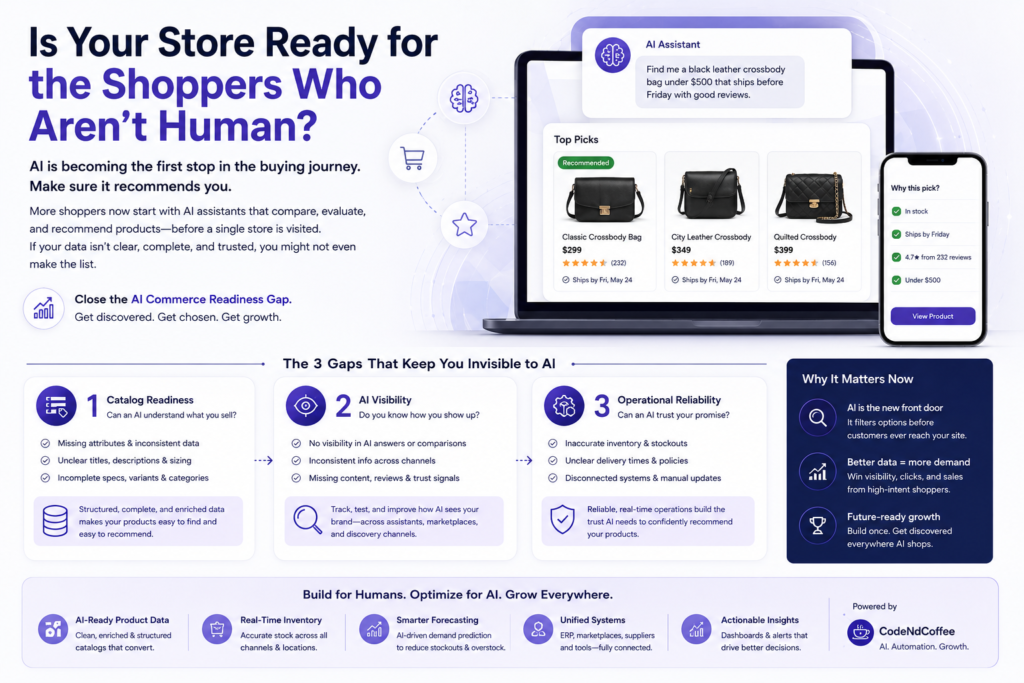
Your store will not only be read by human customers. It may also be read by AI agents.
That means your business needs:
-
Clean product data
-
Structured attributes
-
Clear policies
-
Accurate pricing
-
Reliable inventory
-
Strong product schema
-
Fast APIs
-
Trustworthy content
-
Clear product comparisons
-
Good reviews
-
Consistent brand information
AI agents will prefer stores that are easier to understand, easier to search, and easier to transact with.
For e-commerce businesses, operational AI agents and customer-facing agentic commerce are connected.
If your internal product data, inventory, and workflows are messy, your customer-facing AI experience will also be weak.
The foundation of agentic commerce is operational readiness.
Security and Risk Considerations
AI agents need careful governance.
Because agents may access customer data, order details, product information, and business systems, security must be designed from the beginning.
Important safeguards include:
-
Role-based permissions
-
Limited tool access
-
Human approval for sensitive actions
-
Audit logs
-
Data privacy controls
-
Secure API connections
-
Prompt injection protection
-
Customer data masking
-
Error monitoring
-
Escalation rules
-
Rate limits
-
Testing environments
-
Admin controls
For example, a customer support agent should not have permission to change product prices. A catalog agent should not approve refunds. An inventory agent should not access private customer messages unless required.
Each agent should have a clear role and limited permissions.
This is similar to how human employees have role-based access in an admin panel.
AI agents should follow the same principle.
Measuring ROI from AI Agents
AI agents should be measured like any other business system.
The right metrics depend on the use case.
Customer Support Metrics
-
Average response time
-
First response time
-
Ticket resolution time
-
Percentage of tickets assisted by AI
-
Human escalation rate
-
Customer satisfaction
-
Support cost per ticket
-
Repeated question reduction
Inventory Metrics
-
Stockout reduction
-
Overstock reduction
-
Reorder accuracy
-
Slow-moving stock detection
-
Forecasting accuracy
-
Purchase order preparation time
-
Inventory mismatch reduction
Catalog Metrics
-
Products enriched per day
-
Product listing time
-
Missing field reduction
-
SEO metadata completion
-
Marketplace rejection reduction
-
Product content quality score
Order Operations Metrics
-
Delayed order detection
-
Manual review time
-
Shipping exception response time
-
Fraud review support
-
Order processing efficiency
Marketing Metrics
-
Campaign creation time
-
Email draft speed
-
Product recommendation performance
-
Conversion improvement
-
Customer segmentation quality
-
Revenue per campaign
Management Metrics
-
Reporting time saved
-
Faster decision-making
-
Fewer manual dashboard checks
-
Better visibility into operations
-
Team productivity improvement
The goal is not to say, “We added AI.”
The goal is to say:
“We reduced manual support work by 30%.”
“We cut product listing time in half.”
“We detected stockout risks earlier.”
“We reduced marketplace feed errors.”
“We improved product content quality.”
“We gave managers faster operational visibility.”
That is how AI agents become a real business investment.
Why Work with CodeNdCoffee for E-Commerce AI Agents?
AI agents for e-commerce operations require more than a simple chatbot plugin.
A useful AI agent needs:
-
E-commerce domain understanding
-
Clean data architecture
-
API integrations
-
Business workflow design
-
Secure permissions
-
Human approval logic
-
Admin dashboards
-
Monitoring
-
Reporting
-
Custom development
-
Long-term maintainability
CodeNdCoffee helps e-commerce businesses design and build practical AI-powered systems that connect with real business operations.
Our team works with e-commerce platforms, custom Laravel systems, Shopify stores, marketplace integrations, supplier workflows, inventory systems, AI product enrichment, and business dashboards.
We can help e-commerce brands build:
-
AI customer support agents
-
AI catalog management agents
-
AI inventory monitoring agents
-
AI supplier management agents
-
AI marketplace operations agents
-
AI reporting assistants
-
AI product enrichment workflows
-
AI marketing operations assistants
-
Human-in-the-loop approval systems
-
Custom AI dashboards
-
Shopify AI automations
-
Laravel-based AI operations systems
Our approach is practical and business-focused.
We do not recommend AI for the sake of hype. We look at your existing workflows, identify operational bottlenecks, design the right data structure, and build AI agents that can support your team safely.
For many e-commerce businesses, the best opportunity is not replacing people. It is giving people better systems.
AI agents can help your team work faster, reduce repetitive tasks, improve decision-making, and create a better customer experience.
Final Thoughts
AI agents are becoming an important part of e-commerce operations.
They can help with customer support, product catalog management, inventory monitoring, supplier workflows, order management, returns, marketplace feeds, marketing, reporting, and merchandising.
But successful AI agent implementation requires the right foundation.
Before an e-commerce business gives AI agents more responsibility, it needs:
-
Clean product data
-
Accurate inventory
-
Clear policies
-
Connected systems
-
Defined workflows
-
Secure permissions
-
Human approval steps
-
Reliable reporting
-
Strong technical architecture
AI agents are not magic. They are powerful when connected to real data, clear business rules, and practical workflows.
For e-commerce brands, the next competitive advantage will come from intelligent operations.
The businesses that prepare now will be able to respond faster, list products faster, support customers better, manage inventory smarter, and operate with more clarity.
AI agents for e-commerce operations are not just a future trend.
They are becoming a practical way to build a more scalable, efficient, and intelligent e-commerce business.
If your e-commerce business is ready to reduce manual work, improve operations, and build AI-powered workflows, CodeNdCoffee can help you design and develop the right AI agent system.
Enjoyed this article?
Share it with your network